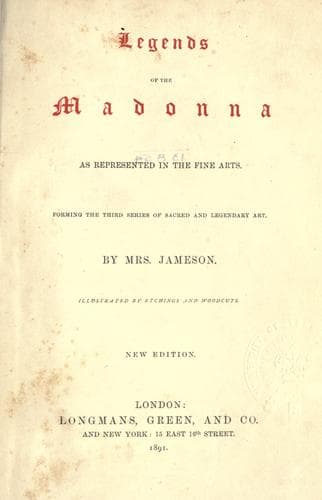
Legends of the Madonna as Represented in the Fine ArtsJameson, Mrs. (Anna)
Religion
Legends of the Madonna as Represented in the Fine Arts
Jameson, Mrs. (Anna)
Christian saints in art; Mary, Blessed Virgin, Saint -- Art; Mary, Blessed Virgin, Saint -- Legends
At length, in July, 1615, Paul V. formally instituted the office
commemorating the Immaculate Conception, and in 1617 issued a bull
forbidding any one to teach or preach a contrary opinion. "On the
publication of this bull, Seville flew into a frenzy of religious
joy." The archbishop performed a solemn service in the Cathedral.
Cannon roared, and bull fights, tournaments, and banquets celebrated
this triumph of the votaries of the Virgin. Spain and its dependencies
were solemnly placed under the protection of the "Immaculate
Conception," thus personifying an abstract idea; and to this day, a
Spaniard salutes his neighbour with the angelic "Ave Maria purissima!"
and he responds "Sin peccado concepida!"[1]
[Footnote 1: In our own days we have seen this curious controversy
revived. One of the latest, if not the last, writer on the subject was
Cardinal Lambruschini; and the last papal ordinance was promulgated by
Pio Mono, and dated from Gaeta, 1849.]
* * * * *
I cannot find the date of the earliest picture of the Immaculate
Conception; but the first writer on the art who makes allusion to the
subject, and lays down specific rules from ecclesiastical authority
for its proper treatment, is the Spaniard Pacheco, who must have been
about forty years of age when the bull was published at Seville in
1618. It is soon after this time that we first hear of pictures of the
Immaculate Conception. Pacheco subsequently became a familiar of the
Inquisition, and wielded the authority of the holy office as inspector
of sacred pictures; and in his "Arte de la Pintura," published in
1649, he laid down those rules for the representation which had been
generally, though not always, exactly followed.
It is evident that the idea is taken from the woman in the Apocalypse,
"clothed with the sun, having the moon under her feet, and on her head
a crown of twelve stars." The Virgin is to be portrayed in the first
spring and bloom of youth as a maiden of about twelve or thirteen
years of age; with "grave sweet eyes;" her hair golden; her features
"with all the beauty painting can express;" her hands are to be folded
on her bosom or joined in prayer. The sun is to be expressed by a
flood of light around her. The moon under her feet is to have the
horns pointing downwards, because illuminated from above, and the
twelve stars are to form a crown over her head. The robe must be
of spotless white; the mantle or scarf blue. Round her are to hover
cherubim bearing roses, palms, and lilies; the head of the bruised and
vanquished dragon is to be under her feet. She ought to have the cord
of St. Francis as a girdle, because in this guise she appeared to
Beatriz de Silva, a noble Franciscan nun, who was favoured by a
celestial vision of the Madonna in her beatitude. Perhaps the good
services of the Franciscans as champions of the Immaculate Conception
procured them the honour of being thus commemorated.
Public-domain text, read in full here on John Shaqi.
Reviews
Reviews
No reviews yet
Be the first to share your thoughts on this work.
Elsewhere in the archive
Join the Discussion
Join the discussion
Sign in to leave a comment or review.
Sign InorCreate an account