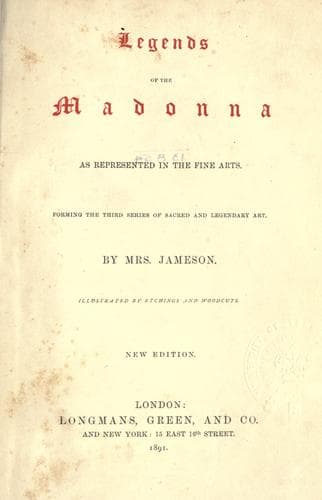
Legends of the Madonna as Represented in the Fine ArtsJameson, Mrs. (Anna)
Religion
Legends of the Madonna as Represented in the Fine Arts
Jameson, Mrs. (Anna)
Christian saints in art; Mary, Blessed Virgin, Saint -- Art; Mary, Blessed Virgin, Saint -- Legends
[Footnote 4: Girolamo Marchesi da Cotignola, was a painter of the
Francia school, whose works date from about 1508 to 1550. Those of
his pictures which I have seen are of very unequal merit, and, with
much feeling and expression in the heads, are often mannered and
fantastic as compositions. This agrees with what Vasari says, that his
excellence lay in portraiture, for which reason he was summoned, after
the battle of Ravenna, to paint the portrait of Caston de Foix, as
he lay dead. (See Vasari, _Vita di Bagnacavallo_; and in the English
trans., vol. iii. 331.) The picture above described, which has a sort
of historical interest, is perhaps the same mentioned in Murray's
Handbook (Central Italy, p. 110.) as an _enthroned_ Madonna, dated
1513, and as being in 1843 in its original place over the altar in the
Serviti at Pesaro; if so, it is there no longer.]
DEVOTIONAL SUBJECTS.
PART II.
THE VIRGIN AND CHILD.
1. LA VERGINE MADRE DI DIO. 2. LA MA DRE AMABILE.
THE VIRGIN AND CHILD ENTHRONED.
_Lat._ Sancta Dei Genitrix. Virgo Deipara. _Ital._ La Santissima
Vergine, Madre di Dio. _Fr._ La Sainte Vierge, Mère de Dieu. _Ger._
Die Heilige Mutter Gottes.
The Virgin in her maternal character opens upon us so wide a field
of illustration, that I scarce know where to begin or how to find my
way, amid the crowd of associations which press upon me. A mother
holding her child in her arms is no very complex subject; but like a
very simple air constructed on a few expressive notes, which, when
harmonized, is susceptible of a thousand modulations, and variations,
and accompaniments, while the original _motif_ never loses its power
to speak to the heart; so it is with the MADONNA AND CHILD;--a
subject so consecrated by its antiquity, so hallowed by its profound
significance, so endeared by its associations with the softest and
deepest of our human sympathies, that the mind has never wearied of
its repetition, nor the eye become satiated with its beauty. Those who
refuse to give it the honour due to a religious representation, yet
regard it with a tender half-unwilling homage; and when the glorified
type of what is purest, loftiest, holiest in womanhood, stands before
us, arrayed in all the majesty and beauty that accomplished Art,
inspired by faith and love, could lend her, and bearing her divine
Son, rather enthroned than sustained on her maternal bosom, "we look,
and the heart is in heaven!" and it is difficult, very difficult, to
refrain from an _Ora pro Nobis_. But before we attempt to classify
these lovely and popular effigies, in all their infinite variety,
from the enthroned grandeur of the Queen of Heaven, the SANCTA
DEI GENITRIX, down to the peasant mother, swaddling or suckling
her infant; or to interpret the innumerable shades of significance
conveyed by the attendant accessories, we must endeavour to trace the
representation itself to its origin.
Public-domain text, read in full here on John Shaqi.
Reviews
Reviews
No reviews yet
Be the first to share your thoughts on this work.
Elsewhere in the archive
Join the Discussion
Join the discussion
Sign in to leave a comment or review.
Sign InorCreate an account