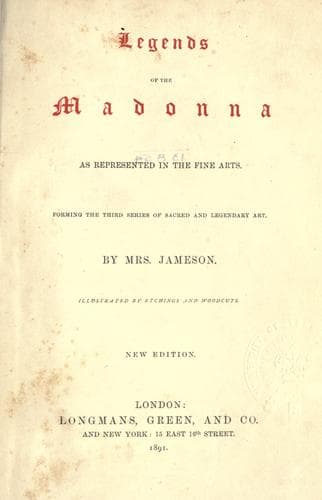
Legends of the Madonna as Represented in the Fine ArtsJameson, Mrs. (Anna)
Religion
Legends of the Madonna as Represented in the Fine Arts
Jameson, Mrs. (Anna)
Christian saints in art; Mary, Blessed Virgin, Saint -- Art; Mary, Blessed Virgin, Saint -- Legends
This is difficult. There exists no proof, I believe, that the effigies
of the Virgin with the infant Christ in her arms, which existed before
the end of the fifth century, were placed before Christian worshippers
as objects of veneration. They appear to have been merely groups
representing a particular incident of the New Testament, namely,
the adoration of the Magi; for I find no other in which the mother
is seated with the infant Christ, and this is an historical subject
of which we shall have to speak hereafter. From the beginning of
the fourth century, that is, from the time of Constantine and the
condemnation of Arius, the popular reverence for the Virgin, the
Mother of Christ, had been gaining ground; and at the same time the
introduction of images and pictures into the places of worship and
into the houses of Christians, as ornaments on glass vessels and even
embroidered on garments and curtains, became more and more diffused,
(v. Neander's Church History.)
The earliest effigies of the Virgin and Child may be traced
to Alexandria, and to Egyptian influences; and it is as easily
conceivable that the time-consecrated Egyptian myth of Isis and
Horus may have suggested the original type, the outward form and the
arrangement of the maternal group, as that the classical Greek types
of the Orpheus and Apollo should have furnished the early symbols of
the Redeemer as the Good Shepherd; a fact which does not rest upon
supposition, but of which the proofs remain to us in the antique
Christian sculptures and the paintings in the catacombs.
The most ancient Greek figures of the Virgin and Child have perished;
but, as far as I can learn, there is no evidence that these effigies
were recognized by the Church as sacred before the beginning of the
sixth century. It was the Nestorian schism which first gave to the
group of the Mother bearing her divine Son that religious importance
and significance which it has ever since retained in Catholic
countries.
The divinity of Christ and his miraculous conception, once established
as articles of belief, naturally imparted to Mary, his mother, a
dignity beyond that of other mothers her Son was God; therefore the
title of MOTHER OF GOD was assigned to her. When or by whom first
brought into use, does not appear; but about the year 400 it became
a popular designation.
Public-domain text, read in full here on John Shaqi.
Reviews
Reviews
No reviews yet
Be the first to share your thoughts on this work.
Elsewhere in the archive
Join the Discussion
Join the discussion
Sign in to leave a comment or review.
Sign InorCreate an account