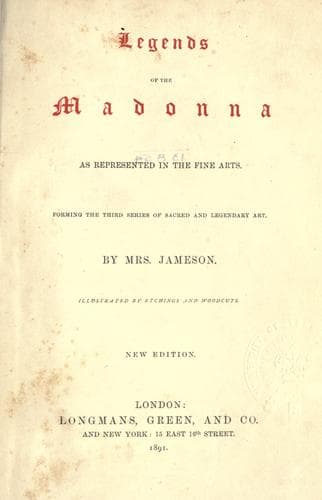
Legends of the Madonna as Represented in the Fine ArtsJameson, Mrs. (Anna)
Religion
Legends of the Madonna as Represented in the Fine Arts
Jameson, Mrs. (Anna)
Christian saints in art; Mary, Blessed Virgin, Saint -- Art; Mary, Blessed Virgin, Saint -- Legends
The long continuance of this controversy, the obstinacy of the
Nestorians, the passionate zeal of those who held the opposite
doctrines, and their ultimate triumph when the Western Churches of
Rome and Carthage declared in their favour, all tended to multiply and
disseminate far and wide throughout Christendom those images of the
Virgin which exhibited her as Mother of the Godhead. At length the
ecclesiastical authorities, headed by Pope Gregory the Great, stamped
them as orthodox: and as the cross had been the primeval symbol which
distinguished the Christian from the Pagan, so the image of the Virgin
Mother with her Child now became the symbol which distinguished the
Catholic Christian from the Nestorian Dissenter.
Thus it appears that if the first religious representations of the
Virgin and Child were not a consequence of the Nestorian schism, yet
the consecration of such effigies as the visible form of a theological
dogma to the purposes of worship and ecclesiastical decoration
must date from the Council of Ephesus in 431; and their popularity
and general diffusion throughout the western Churches, from the
pontificate of Gregory in the beginning of the seventh century.
In the most ancient of these effigies which remain, we have clearly
only a symbol; a half figure, veiled, with hands outspread, and
the half figure of a child placed against her bosom, without any
sentiment, without even the action of sustaining him. Such was the
formal but quite intelligible sign; but it soon became more, it became
a representation. As it was in the East that the cause of the Virgin
first triumphed, we might naturally expect to find the earliest
examples in the old Greek churches; but these must have perished
in the furious onslaught made by the Iconoclasts on all the sacred
images. The controversy between the image-worshippers and the
image-breakers, which distracted the East for more than a century
(that is, from 726 to 840), did not, however, extend to the west of
Europe. We find the primeval Byzantine type, or at least the exact
reproduction of it, in the most ancient western churches, and
preserved to us in the mosaics of Rome, Ravenna, and Capua. These
remains are nearly all of the same date, much later than the single
figures of Christ as Redeemer, and belonging unfortunately to a lower
period and style of art. The true significance of the representation
is not, however, left doubtful; for all the earliest traditions and
inscriptions are in this agreed, that such effigies were intended as
a confession of faith; an acknowledgment of the dignity of the Virgin
Mary, as the "SANCTA DEI GENITRIX;" as a visible refutation of "the
infamous, iniquitous, and sacrilegious doctrines of Nestorius the
Heresiarch."[1]
[Footnote 1: _Mostrando quod ipsa Deipara esset contra impiam Nestorii
Heresium quam talem esse iste Heresiareo negabat_ Vide Ciampini, and
Munter's "Sinnbilder."]
* * * * *
Public-domain text, read in full here on John Shaqi.
Reviews
Reviews
No reviews yet
Be the first to share your thoughts on this work.
Elsewhere in the archive
Join the Discussion
Join the discussion
Sign in to leave a comment or review.
Sign InorCreate an account