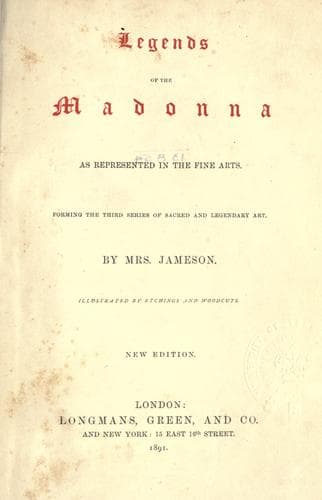
Legends of the Madonna as Represented in the Fine ArtsJameson, Mrs. (Anna)
Religion
Legends of the Madonna as Represented in the Fine Arts
Jameson, Mrs. (Anna)
Christian saints in art; Mary, Blessed Virgin, Saint -- Art; Mary, Blessed Virgin, Saint -- Legends
Nestorias, patriarch of Constantinople in 428, had begun by
persecuting the Arians; but while he insisted that in Jesus were
combined two persons and two natures, he insisted that the Virgin Mary
was the mother of Christ considered as _man_, but not the mother of
Christ considered as _God_; and that, consequently, all those who gave
her the title of _Dei Genitrix_, _Deipara_,[1] were in error. There
were many who adopted these opinions, but by a large portion of the
Church they were repudiated with horror, as utterly subverting the
doctrine of the mystery of the Incarnation. Cyril of Alexandria
opposed Nestorius and his followers, and defended with zealous
enthusiasm the claims of the Virgin to all the reverence and
worship due to her; for, as he argued, the two natures being one and
indivisible from the moment of the miraculous conception, it followed
that Mary did indeed bring forth God,--was, in fact, the mother of
God; and, all who took away from her this dignity and title were in
error, and to be condemned as heretics.
[Footnote 1: The inscription on the Greek and Byzantine pictures is
actually [Greek: MAeR ThU] ([Greek: Mhaetaer Theos]).]
I hope I shall not be considered irreverent in thus plainly and simply
stating the grounds of this celebrated schism, with reference to its
influence on Art; an influence incalculable, not only at the time,
but ever since that time; of which the manifold results, traced
from century to century down to the present hour, would remain quite
unintelligible, unless we clearly understood the origin and the issue
of the controversy.
Cyril, who was as enthusiastic and indomitable as Nestorius, and had
the advantage of taking the positive against the negative side of the
question, anathematized the doctrines of his opponent, in a synod held
at Alexandria in 430, to which Pope Celestine II gave the sanction of
his authority. The emperor Theodosius II then called a general council
at Ephesus in 431, before which Nestorius refused to appear, and was
deposed from his dignity of patriarch by the suffrages of 200 bishops.
But this did not put an end to the controversy; the streets of Ephesus
were disturbed by the brawls and the pavement of the cathedral was
literally stained with the blood of the contending parties Theodosius
arrested both the patriarchs; but after the lapse of only a few days,
Cyril triumphed over his adversary: with him triumphed the cause of
the Virgin. Nestorius was deposed and exiled; his writings condemned
to the flames; but still the opinions he had advocated were adopted by
numbers, who were regarded as heretics by those who called themselves
"the Catholic Church."
Public-domain text, read in full here on John Shaqi.
Reviews
Reviews
No reviews yet
Be the first to share your thoughts on this work.
Elsewhere in the archive
Join the Discussion
Join the discussion
Sign in to leave a comment or review.
Sign InorCreate an account