[Illustration: CORONATION OF CHARLEMAGNE.--Levy.]
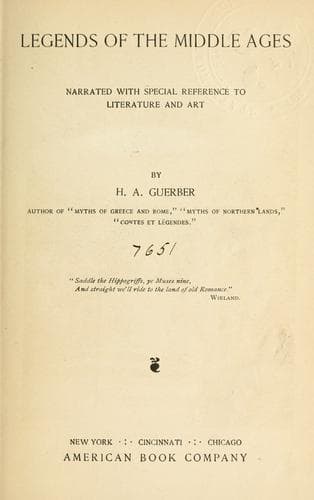
LEGENDS OF THE MIDDLE AGES
NARRATED WITH SPECIAL REFERENCE TO LITERATURE AND ART
BY H.A. GUERBER
"Saddle the Hippogriffs, ye Muses nine,
And straight we'll ride to the land of old Romance"
WIELAND
1896
DEDICATED TO MY SISTER ADELE E. GUERBER
"Men lykyn jestis for to here,
And romans rede in diuers manere
"Of Brute that baron bold of hond,
The first conqueroure of Englond;
Of kyng Artour that was so riche,
Was non in his tyme him liche.
"How kyng Charlis and Rowlond fawght
With sarzyns nold they be cawght;
Of Tristrem and of Ysoude the swete,
How they with love first gan mete;
"Stories of diuerce thynggis,
Of pryncis, prelatis, and of kynggis;
Many songgis of diuers ryme,
As english, frensh, and latyne."
_Curser Mundi_.
PREFACE.
The object of this work is to familiarize young students with the legends
which form the staple of mediaeval literature.
While they may owe more than is apparent at first sight to the classical
writings of the palmy days of Greece and Rome, these legends are very
characteristic of the people who told them, and they are the best exponents
of the customs, manners, and beliefs of the time to which they belong. They
have been repeated in poetry and prose with endless variations, and some of
our greatest modern writers have deemed them worthy of a new dress, as is
seen in Tennyson's "Idyls of the King," Goethe's "Reineke Fuchs," Tegnér's
"Frithiof Saga," Wieland's "Oberon," Morris's "Story of Sigurd," and many
shorter works by these and less noted writers.
These mediaeval legends form a sort of literary quarry, from which,
consciously or unconsciously, each writer takes some stones wherewith to
build his own edifice. Many allusions in the literature of our own day lose
much of their force simply because these legends are not available to the
general reader.
It is the aim of this volume to bring them within reach of all, and to
condense them so that they may readily be understood. Of course in so
limited a space only an outline of each legend can be given, with a few
short quotations from ancient and modern writings to illustrate the style
of the poem in which they are embodied, or to lend additional force to some
point in the story.
This book is, therefore, not a manual of mediaeval literature, or a series
of critical essays, but rather a synopsis of some of the epics and romances
which formed the main part of the culture of those days. Very little
prominence has been given to the obscure early versions, all disquisitions
have been carefully avoided, and explanations have been given only where
they seemed essential.
Public-domain text, read in full here on John Shaqi.
Reviews
Reviews
No reviews yet
Be the first to share your thoughts on this work.
Join the Discussion
Join the discussion
Sign in to leave a comment or review.
Sign InorCreate an account