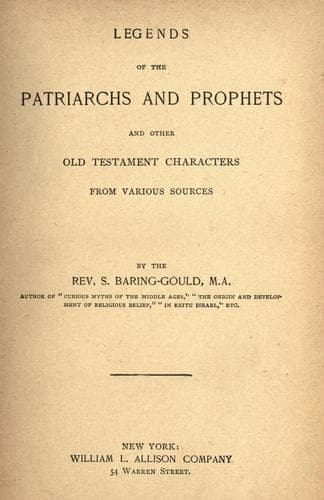
Legends of the Patriarchs and Prophets: And Other Old Testament Characters from Various SourcesBaring-Gould, S. (Sabine)
Religion
Legends of the Patriarchs and Prophets: And Other Old Testament Characters from Various Sources
Baring-Gould, S. (Sabine)
Bible. Old Testament -- Legends
The natives of the Caroline Islands relate that one of the inferior
gods, named Merogrog, was driven by the other gods out of heaven,
and he took with him a spark of fire which he gave to men.[16] This
myth resembles that of Prometheus, “the contriver, full of gall and
bitterness, who sinned against the gods by bestowing their honors
on creatures of a day, the thief of fire,” as Hermes calls him. He
reappears as Tohil among the Quiches, the giver of fire, hated, yet
adored.
The Northern Californians say that the supreme God once created
invisible spirits, of whom one portion revolted against him, headed
by a spirit named War or Touparan, and that the Great Spirit having
overcome him, drove him from the plains of heaven, and confined him
along with his comrades in a cavern, where he is guarded by whales.[17]
The Egyptian Typhon, already alluded to, did not belong to Egypt alone,
but also to Phœnicia and Asia Minor, and thence the story passed into
Greece, where it took root, and has been preserved to us as the attack
of the hundred-headed dragon against the heaven-god Zeus. Typhon
desired to obtain supremacy over gods and men, and, in order to win
for himself this sovereignty, he fought against the gods; but he was
defeated, bound, and precipitated into Tartarus, or, according to
another version, was buried under the flaming mountains.
According to a tradition of the Salivas, a people of New Granada, a
serpent slew the nations, descended from God, who inhabited the region
of the Orinoco, but a son of the God Puru fought him and overcame
him, and bade him depart with his curse, and never to enter his house
again, and, say these Salivas, from the flesh of the serpent sprang the
Caribees, their great foes, as maggots from putrid meat.[18]
But these stories might be infinitely extended. How far they refer to
a tradition common to the human race, and how far they relate to the
strife between summer and winter, sun and storm-cloud, I do not pretend
to decide. It is one of those vexed questions which it is impossible to
determine.
II.
ADAM.
1. THE CREATION OF MAN.
Certain of the angels having fallen, God made men, that they might take
their vacated places.
According to the most authoritative Mussulman traditions, Adam was
created on Friday afternoon at the Assr-hour, or about three o’clock.
The four archangels--Gabriel, Michael, Israfiel, and Asrael--were
required to bring earth from the four quarters of the world, that
therefrom God might fashion man. His head and breast were made of
clay from Mecca and Medina, from the spot where later were the Holy
Kaaba and the tomb of Mohammed. Although still lifeless, his beauty
amazed the angels who had flocked to the gates of Paradise. But
Eblis, envious of the beauty of Adam’s as yet inanimate form, said to
the angels: “How can you admire a creature made of earth? From such
material nothing but fragility and feebleness can come.” However, most
of the angels praised God for what he had done.
Public-domain text, read in full here on John Shaqi.
Reviews
Reviews
No reviews yet
Be the first to share your thoughts on this work.
Join the Discussion
Join the discussion
Sign in to leave a comment or review.
Sign InorCreate an account