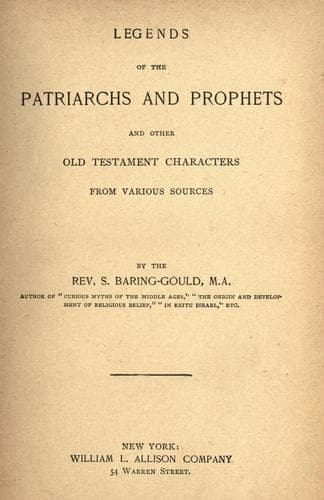
Legends of the Patriarchs and Prophets: And Other Old Testament Characters from Various SourcesBaring-Gould, S. (Sabine)
Religion
Legends of the Patriarchs and Prophets: And Other Old Testament Characters from Various Sources
Baring-Gould, S. (Sabine)
Bible. Old Testament -- Legends
And now a famine came upon the land; this was the third famine since
the world was formed, and it was sent to prove Abraham. He murmured
not, but went down with Sarah his wife, and his servants.
When he reached the River of Egypt (Wadi el Arisch), Abraham rested
some days. As Abraham and Sarah walked together by the water-side,
Abraham saw for the first time, reflected in the water, the beauty of
Sarah; for he was so modest that he had never lifted his eyes to her
face, and knew not what she was like, till he saw her in the water.
Then, when he saw how beautiful she was, he persuaded her to pass as
his sister in Egypt, for he feared lest he should be slain for her
sake; but as a further precaution he shut her up in a chest.
On the frontier, the Custom-house officers insisted on his paying
the customs, due for the box, and required that it should be opened.
Abraham offered to pay for the box as if it contained gold dust or
gems, if only they would not enforce their right of search.
“Does it contain silk?” asked the officers.
“I will pay the tenth, as of silk,” he answered.
“Does it contain silver?” they further asked.
“I will pay for it as silver.”
“Nay, then it must contain gold.”
“I will pay for it as gold.”
“Maybe it contains the most rare and costly gems.”
“I will pay for it as for gems.”
In the altercation the chest was violently broken open, and lo! in
it was seated a beautiful woman, so beautiful that her countenance
illumined all Egypt; and the news reached the ears of Pharaoh. All this
occurred in the night of the 15th of the month Nisan.
Abraham and Sarah were sorely troubled, and prayed to God to protect
them. Then the angel of the Lord was sent to watch over Sarah, and the
angel comforted her with these words, “Fear not; God has heard thy
petitions!”
Pharaoh asked Sarah who that man was who accompanied her, and when she
answered “My brother,” Pharaoh bade him to be brought before him, and
he gave him rich gifts.
And Pharaoh asked Abraham, “Who is this woman?” He answered “She is my
sister.” This say the Mussulmans, is the _third_ lie that Abraham told;
but it was not a lie, but a justifiable falsehood.
Pharaoh was filled with love for Sarah, and he offered her as his
present for her hand, all his possessions of gold and silver and
slaves, and the land of Goshen. And when he pressed his suit upon her
with great vehemence, she cried to God and told him she was already
married; then he was smitten with paralysis, and great plagues
afflicted all his servants. But Pharaoh sent for Abraham, and returned
him Sarah, his wife, and dismissed him with costly presents, and he
gave to Sarah also his daughter, Hagar, to be her servant.
“Truly, my daughter, it is better,” said Pharaoh, “to be servant in
a house which God has taken under His protection, than to command
elsewhere.”
After a three months’ sojourn in Egypt, Abraham returned to Canaan.
Public-domain text, read in full here on John Shaqi.
Reviews
Reviews
No reviews yet
Be the first to share your thoughts on this work.
Elsewhere in the archive
Join the Discussion
Join the discussion
Sign in to leave a comment or review.
Sign InorCreate an account