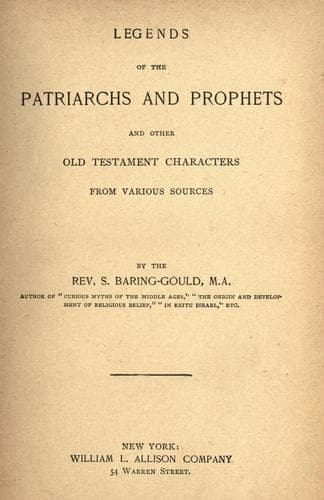
Legends of the Patriarchs and Prophets: And Other Old Testament Characters from Various SourcesBaring-Gould, S. (Sabine)
Religion
Legends of the Patriarchs and Prophets: And Other Old Testament Characters from Various Sources
Baring-Gould, S. (Sabine)
Bible. Old Testament -- Legends
According to Tabari, Hagar loved Sarah greatly. On their way back to
Canaan the provisions failed, and Abraham went out one day to get food,
with a sack on his back; but the day was hot, so that he laid down and
went to sleep. He did not awake till evening, and then he returned, but
was ashamed to appear with the sack empty before his wife, so he filled
it with sand. On reaching the tent he put the sack under his head and
went to sleep again. Very early in the morning Sarah said to Hagar,
“What has Abraham in his sack? open it and look.” So Hagar untied it,
put in her hand and drew out flour. She and Sarah baked cakes of the
flour, and woke Abraham and bade him eat. Then, full of wonder, he
asked where they had obtained meal. They told him, and he understood
that God had wrought a miracle.[305]
Now Abraham’s flocks and herds, and those of Lot, pastured together.
Abraham’s cattle were muzzled that they should not feed in the lands of
the neighbouring people; but Lot’s cattle were not muzzled. And when
Abraham’s shepherds complained of this to those of Lot, the latter
answered, “Your master is old, and has no children; soon he will die,
and then all will belong to our master Lot.”
But Abraham spake to Lot and said, “Thy ways and my ways do not agree:
we must part; do thou go to the left, and I will go to the right.” So
they separated; and Lot departed from Abraham, and from the way of
righteousness, and from the living God; but Abraham camped in Mamre.
3. THE WAR WITH THE KINGS.
After the failure of the Tower of Babel, and the people had been
scattered over the whole earth, Chedorlaomer, one of Nimrod’s chief
captains, had left his service, and had established a kingdom of his
own in Elam. He speedily brought into subjection all the Canaanitish
peoples that dwelt in the fertile valley of Jordan,--Sodom, Gomorrah,
Admah, Zebojim, and Zoar, and made them tributary to himself. These
cities bore his yoke for twelve years, and then they rebelled. Five
years after did Nimrod, who is also called Amraphel in the sacred
text,[306] march against Chedorlaomer, but Nimrod was defeated, along
with his allies, Arioch, king of Ellasar, and Tidal, king of many
confederate nations; and obliged to enter into alliance with his former
general, Chedorlaomer, and agree to assist him in bringing back the
revolted cities--Sodom, Gomorrah, Admah, Zebojim, and Zoar--to their
allegiance.
Consequently a huge army of confederates, under Chedorlaomer, Nimrod or
Amraphel, Arioch, and Tidal, overran the plain and valley of Jordan,
and slew all the giants that were there. The country before them was a
garden, and behind them it was a desert.
They resolved also to defeat, and utterly to destroy Abraham, the
servant of the Most High; for Nimrod (Amraphel) remembered the perils
to which his soothsayers had assured him he was exposed so long as
Abraham lived.
Public-domain text, read in full here on John Shaqi.
Reviews
Reviews
No reviews yet
Be the first to share your thoughts on this work.
Elsewhere in the archive
Join the Discussion
Join the discussion
Sign in to leave a comment or review.
Sign InorCreate an account