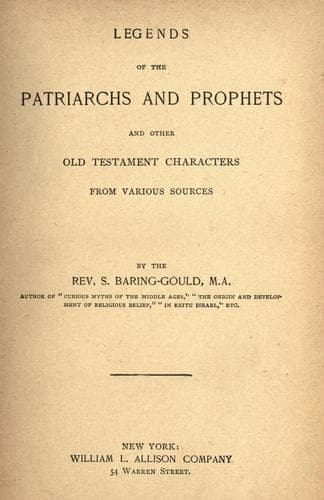
Legends of the Patriarchs and Prophets: And Other Old Testament Characters from Various SourcesBaring-Gould, S. (Sabine)
Religion
Legends of the Patriarchs and Prophets: And Other Old Testament Characters from Various Sources
Baring-Gould, S. (Sabine)
Bible. Old Testament -- Legends
Many are the origins attributed to man in the various creeds of ancient
and modern heathendom. Sometimes he is spoken of as having been made
out of water, but more generally it is of earth that he has been made,
or from which he has been spontaneously born. The Peruvians believed
that the world was peopled by four men and four women, brothers and
sisters, who emerged from the caves near Cuzco. Among the North
American Indians the earth is regarded as the universal mother. Men
came into existence in her womb, and crept out of it by climbing up
the roots of the trees which hung from the vault in which they were
conceived and matured; or, mounting a deer, the animal brought them
into daylight; or, groping in darkness, they tore their way out with
their nails.[32]
The Egyptian philosophers pretended that man was made of the mud
of the Nile.[33] In Aristophanes,[34] man is spoken of as πλάσματα
πηλοῦ. Among some of the Chinese it is believed that man was thus
formed:--“The book Fong-zen-tong says: When the earth and heaven were
made, there was not as yet man or peoples. Then Niu-hoa moulded yellow
earth, and of that made man. That is the true origin of men.”[35]
And the ancient Chaldeans supposed man was made by the mixing of the
blood of Belus with the soil.[36]
2. THE PRE-ADAMITES.
In 1655, Isaac de la Peyreira, a converted Jew, published a curious
treatise on the Pre-Adamites. Arguing upon Romans v. 12-14, he
contended that there were two creations of man; that recorded in the
first chapter of Genesis and that described in the second chapter
being distinct. The first race he supposed to have peopled the whole
world, but that it was bad, and therefore Adam had been created with
a spiritual soul, and that from Adam the Jewish race was descended,
whereas the Gentile nations issued from the loins of the Pre-Adamites.
Consequently the original sin of Adam weighed only on his descendants,
and Peyreira supposed that it was his race alone which perished, with
the exception of Noah and his family, in the Deluge, which Peyreira
contends was partial. This book was condemned and burnt in Paris by
the hands of the executioner, and the author, who had taken refuge in
Brussels, was there condemned by the ecclesiastical authorities. He
appealed to Rome, whither he journeyed, and he was received with favor
by Alexander VII., before whom he abjured Calvinism, which he had
professed.
He died at the age of 82, at Aubervilliers, near Paris, and Moreri
wrote the following epigrammatic epitaph for him:--
“La Peyrère ici gît, ce bon Israélite,
Huguenot, catholique, enfin pré-Adamite.
Quatre religions lui plurent à la fois;
Et son indifférence était si peu commune,
Qu’après quatre-vingts ans qu’il eut à faire un choix,
Le bon homme partit et n’en choisit aucune.”
Public-domain text, read in full here on John Shaqi.
Reviews
Reviews
No reviews yet
Be the first to share your thoughts on this work.
Join the Discussion
Join the discussion
Sign in to leave a comment or review.
Sign InorCreate an account