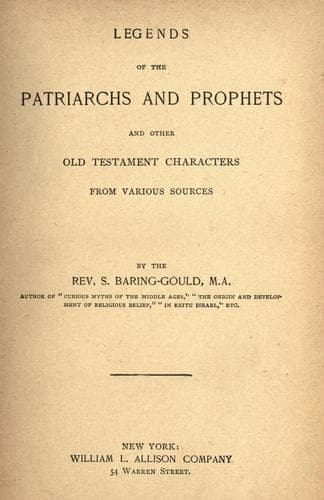
Legends of the Patriarchs and Prophets: And Other Old Testament Characters from Various SourcesBaring-Gould, S. (Sabine)
Religion
Legends of the Patriarchs and Prophets: And Other Old Testament Characters from Various Sources
Baring-Gould, S. (Sabine)
Bible. Old Testament -- Legends
Joseph had now been seven years in prison, and this is why he had been
so long there. Potiphar’s wife persuaded her friends to bring against
Joseph the same accusation that she had laid against him, and their
husbands complained to Pharaoh; so he was kept in prison that he might
not cause strife and evil in the city.[420]
When the seven years were elapsed, one day the butler came to the
prison and bade Joseph follow him, as the King had been troubled
with a dream, and desired to have it explained. But Joseph refused
to leave till his innocence was proclaimed. He named to the butler
the ladies who had attended the banquet of Zuleika, and before whom
she had confessed that she loved him, and besought that they might
be called as witnesses before the king. Pharoah agreed; the ladies,
when interrogated, related all that had been said, and Zuleika herself
confessed the truth.
Then Pharaoh sent and fetched Joseph out of prison, and gave him his
liberty.
“I dreamed,” said the king, when Joseph stood before his throne, “that
seven lean cows ate seven fat cows, and that seven empty husks ate
seven full ears of corn. What is the interpretation of this dream?”
“God will give thee seven fruitful years, and then seven years of
famine,” answered Joseph. “Therefore must thou gather together all the
superfluity in the first seven years to sustain the starving people in
the seven years of dearth.”[421]
The king was so well pleased with this interpretation, that he made
Joseph his chief treasurer in Potiphar’s room. Joseph went through all
the land, and purchased corn, which, on account of the good harvests,
was at a very low price.
One day as he rode out of the town to view his magazines, he observed
a beggar-woman whose whole appearance was most woe-begone, but bespoke
her having seen better days. Joseph approached her with compassion, and
held out to her a handful of gold. She hesitated about taking it, and
said, sobbing, “Great prophet of God! I am not worthy to receive this
at thy hand, though it was my love for thee which was the first step
on the ladder on which thou mountedst to thy present exaltation.” And
Joseph saw that the poor beggar-woman was Zuleika, wife of Potiphar.
He asked about her husband, and learned that shortly after he had been
deposed from office, he had died of distress of mind and body. “Thou
hast thought evil of me,” she said, “but I have great excuses, thou
wast so beautiful; and moreover I was young, and only a wife in name,
for I am as I left my mother’s womb, a maiden, with the seal of God
upon me.”
Public-domain text, read in full here on John Shaqi.
Reviews
Reviews
No reviews yet
Be the first to share your thoughts on this work.
Elsewhere in the archive
Join the Discussion
Join the discussion
Sign in to leave a comment or review.
Sign InorCreate an account