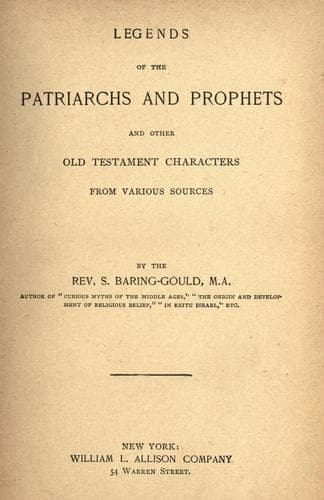
Legends of the Patriarchs and Prophets: And Other Old Testament Characters from Various SourcesBaring-Gould, S. (Sabine)
Religion
Legends of the Patriarchs and Prophets: And Other Old Testament Characters from Various Sources
Baring-Gould, S. (Sabine)
Bible. Old Testament -- Legends
Then Joseph was filled with joy. He extended his hands to her, and he
brought her to the king’s palace, and she was treated there with care
as a sister, till she recovered her bloom and joy, and then Joseph
took her to be his wife.[422] And by her he had two sons before the
seven years of dearth began, during which the Egyptians gave first
their gold, and their apparel and all their movable goods; then their
land, then their slaves, and last of all themselves, their wives and
children, as bondsmen, that they might have food.
But not only did Egypt suffer, the adjoining lands were also afflicted
with scarcity. There was no corn in Canaan, and Jacob sent his ten
sons into Egypt to buy corn, retaining Benjamin at home. He cautioned
his sons not to create mistrust by their numbers, nor cause the evil
eye to light on them, and advised them to enter the city of Pharaoh by
different gates, for it had ten.
But Joseph expected that his brothers would be coming to Egypt, and
therefore he bade the gatekeepers every day bring him the names of
those who had entered the city. One day one porter gave him the name
of Reuben, son of Jacob; and so on to the tenth, Asher, son of Jacob.
Joseph at once gave orders for every storehouse to be closed with the
exception of one, and gave the keepers of the open magazine the names
of his brothers, and said to them, “When these people arrive take them
prisoners, and bring them before me.”
And when they appeared before him, he charged them with being spies:
“For,” said he, “if ye were true men, ye would have come in together;
but ye entered by different gates, and that shows that ye are set upon
evil.”[423]
When, to excuse themselves, they told their family history, he bade
them go and bring Benjamin down to him, and, to secure their return, he
kept Simeon in prison as hostage.
When Joseph wanted to imprison Simeon, his brothers desired to assist
him by force, but Simeon refused their assistance. Joseph ordered
seventy fighting men of Pharaoh’s body-guard to cast him down and
handcuff him. But when they approached, Simeon gave a scream, and
the seventy fell back on the ground, and their teeth went down their
throats. “Hah!” said Joseph to his son Manasseh, who stood near him,
“throw a chain about his neck.”
Manasseh dealt Simeon a blow, and chained him. “Then,” said Simeon,
“this blow comes from one of the family.”[424]
Jacob, reluctant to part with Benjamin, was however obliged to do so,
being pressed with famine. Joseph received the brethren, measured out
to them the wheat, and, by his orders, his steward secretly put the
silver cup of Joseph into the sack of Benjamin. Then at the gate of the
city they were charged with theft, and were brought back to the palace
of Joseph.
“What is the penalty due to him who has stolen my cup?” asked Joseph.
Public-domain text, read in full here on John Shaqi.
Reviews
Reviews
No reviews yet
Be the first to share your thoughts on this work.
Elsewhere in the archive
Join the Discussion
Join the discussion
Sign in to leave a comment or review.
Sign InorCreate an account