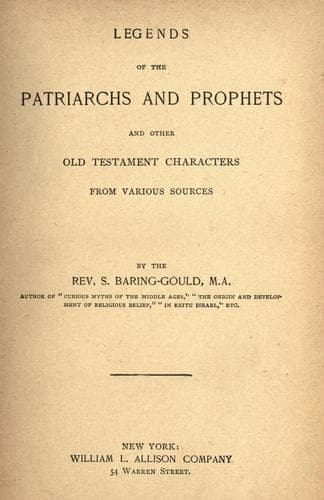
Legends of the Patriarchs and Prophets: And Other Old Testament Characters from Various SourcesBaring-Gould, S. (Sabine)
Religion
Legends of the Patriarchs and Prophets: And Other Old Testament Characters from Various Sources
Baring-Gould, S. (Sabine)
Bible. Old Testament -- Legends
It was a work of Jewish origin, which has been tampered with and
interpolated by Christian copyists. S. Augustine numbers it with
the Apocrypha; he says, “There are the apocryphal books of the Old
Testament: the works falsely attributed to Enoch, the Patriarchs, the
Discourse of Joseph, the Assumption of Moses, the pseudographia of
Abraham, Eldad and Medad, Elias the prophet, the prophet Zephaniah,
Zechariah, Baruch, Habakkuk, Ezekiel, and Daniel.”
Curiously enough, the Testament of the Patriarchs contains a large
number of alleged quotations from the book of Enoch, which are not,
however, to be found in that book as we now have it.
This Testament was read by the Jews at the time of Christ’s coming,
and S. Paul seems to have been acquainted with it, for he quotes it,
“_Awake, thou that sleepest, and arise from the dead_;”[434] and again
he quotes the Testament of Levi, “_The wrath is come upon them to
the uttermost_.”[435] S. Jerome remarks on this, “The Apostle Paul
quoted from the hidden prophets and from those books which are called
Apocrypha,” and he adds, “That he did so in several other places is
very evident.”[436] And Origen says, “It is evident that many examples
were quoted and inserted in the New Testament by the Apostles and the
Evangelists from those Scriptures which we do not read as canonical,
but these passages are found in the apocryphal books, and it is evident
that these passages were extracted from them;” and he gives the reason
why that was lawful to the Apostles which is not lawful to us.
He says, “It may have been, that the Apostles and Evangelists, filled
with the Holy Ghost, may have known what was to be taken from these
writings and what was to be rejected; but for us to presume to do such
a thing would be full of danger, not having the Spirit in the same
measure to guide us.”[437]
Robert Grostête, Bishop of Lincoln, translated the Testament of the
twelve Patriarchs into Latin, in 1242, according to Matthew Paris.
“Also in this time, Robert, Bishop of Lincoln, a man most skilled in
Latin and Greek, translated accurately the Testaments of the Twelve
Patriarchs from the Greek into Latin; which for many years had been
unknown and concealed, through the jealousy of the Jews, because of the
prophecies concerning our Saviour therein contained. But the Greeks,
the most indefatigable investigators of all writings, being the first
who learnt about this, translated it from Hebrew into Greek, and kept
it to themselves until our own time. For in the time of S. Jerome, or
of any other holy interpreter, it could not in any way whatever come
to the knowledge of the Christians, on account of the scheming malice
of the Jews. Therefore the above-named Bishop, assisted by Master
Nicholas, a Greek, and clerk to the Abbey of S. Albans, translated
clearly, evidently, and word for word, into Latin, that glorious
treatise, to the strengthening of the Christian faith, and to the
greater confusion of the Jews.”[438]
Public-domain text, read in full here on John Shaqi.
Reviews
Reviews
No reviews yet
Be the first to share your thoughts on this work.
Elsewhere in the archive
Join the Discussion
Join the discussion
Sign in to leave a comment or review.
Sign InorCreate an account