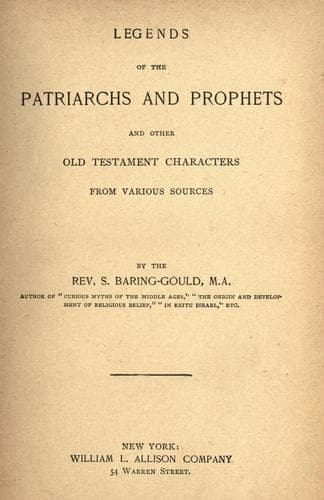
Legends of the Patriarchs and Prophets: And Other Old Testament Characters from Various SourcesBaring-Gould, S. (Sabine)
Religion
Legends of the Patriarchs and Prophets: And Other Old Testament Characters from Various Sources
Baring-Gould, S. (Sabine)
Bible. Old Testament -- Legends
The Testaments were published by Grabe, at Oxford, in 1698, and
were republished by Fabricius in his “Codex Pseudepigraphus Vet.
Testamenti,” at Hamburg, in 1722.[439]
XXX.
JOB.
Job was the great grandson of Esau. He was the son of Amos the son of
Zara, the son of Esau, and he had to wife Rahma, daughter of Ephraim,
son of Joseph. Ephraim left two sons, who were prophets after him; but
amongst the children of Esau there was no prophet, saving Job.
Job was more patient than any other prophet; therefore it is said of
him in the Koran, “Certainly we have found this excellent servant
patient.”[440]
The Rabbis say that Job, Jethro, and Balaam were King Pharaoh’s three
councillors, and they were also his chief magicians. They, by their
enchantments, drew a line round the land of Egypt, so that no slave
could escape out of it; for when he came to the line, he was held back
and could not overleap it. But when the Israelites broke away and
disregarded the enchanted line, Job, Jethro, and Balaam gave up their
witchcrafts, and turned to the service of the living God.[441]
Job lived in Bashan, which lies between Damascus and Ramla, and there
he reigned as a prince. Job had five hundred yoke of oxen, and to every
yoke there was a she-ass to carry the instruments of husbandry. He had
also a thousand flocks of sheep, and a thousand sheep in each flock.
He had ten children, seven sons and three daughters; all were grown
up.[442]
In the “Testament of Job,”[443] we read that this great man, illumined
by the Divine light, comprehended that the idols which his people
adored were no gods, and that there was but one only true God, the
Creator and Preserver of all things. There was near his house an idol
which attracted great worship. He prayed the Lord to show him whether
this idol were a demon or not; and he promised, in that case, to
destroy it and purify the place; and this he was able to do, being a
sovereign.
God sent him an angel, who illumined him, and strengthened him in his
resolution. So he destroyed the idol, and abolished its worship. But
this act drew upon him the wrath of Satan. The angel had foreseen the
disasters which would befall Job if he resolved to strive against the
Evil One, and he had warned Job what to expect; but Job answered that,
being convinced of the truth, he was ready to suffer for it.
Satan presented himself at the door of Job’s house. He had taken upon
him the form of a pilgrim, and he said to the portress, “I desire to
see the faithful servant of the Most High.”
Now Job, who had received the gift of prophecy, knew that this was the
Evil One, and he refused to see him, saying to the gate-keeper when she
brought the message, “Tell him that I am occupied, and that I cannot
receive him.”
Satan retired, but he returned soon after, disguised as a beggar, and
he said to the portress, “Go and ask Job to give me a morsel of bread.”
Public-domain text, read in full here on John Shaqi.
Reviews
Reviews
No reviews yet
Be the first to share your thoughts on this work.
Elsewhere in the archive
Join the Discussion
Join the discussion
Sign in to leave a comment or review.
Sign InorCreate an account