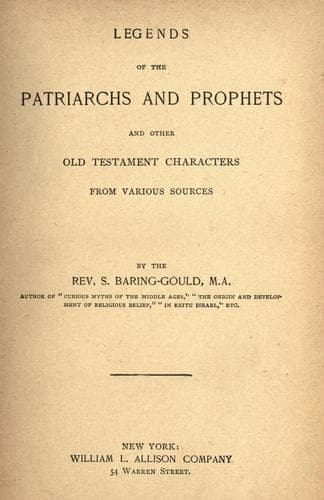
Legends of the Patriarchs and Prophets: And Other Old Testament Characters from Various SourcesBaring-Gould, S. (Sabine)
Religion
Legends of the Patriarchs and Prophets: And Other Old Testament Characters from Various Sources
Baring-Gould, S. (Sabine)
Bible. Old Testament -- Legends
Fields, vineyards, and houses, which Joseph had given to his brethren,
were now reclaimed by the natives of Egypt, and the children of Israel
were enslaved.
The Egyptians, effeminate, and hating work, fond of pleasure and
display, had envied the prosperity of the Hebrews, who had thriven in
Goshen, and whose wives bore sometimes six and sometimes twelve infants
at a birth.
They also feared lest this people, increasing upon them, should become
more numerous than they, and should seize upon the power, and enslave
the native population.
Nine years after the death of Joseph, King Mechron died, and was
succeeded by his son Melol.
But before pursuing the history of the oppression of the Hebrews, we
must relate some events that had occurred before this time.
When the body of Jacob, according to the last will, had been taken to
the cave of Machpelah, Esau and his sons and a large body of followers
hastened to oppose the burial of Jacob. After the death of Isaac, Esau
and Jacob had come to an agreement, by which all the movable property
of the father was made over to Esau, and all that was immovable,
especially the burial cave, was apportioned to Jacob. But now Esau
desired to set aside this agreement, and, as first-born, to claim
the tomb as his, trusting that the sons of Jacob could not prove the
agreement.
But no sooner had he raised this objection, than Naphtali, who was
swift of foot, ran into Egypt, and returned in a few hours with the
writing of agreement.
Esau, seeing himself baffled, had recourse to arms; and a fight took
place, in which Esau was killed, and his followers were put to flight
or taken as captives to Egypt, where they became the slaves of the
Israelites. Amongst those captives was Zepho, son of Eliphaz, son of
Esau.
Even in Joseph’s lifetime, the Edomites made incursions into Egypt to
recover their captive relatives, but their attempts led to no other
result than the tightening of the chains which bound the captives.
Later, however, Zepho succeeded in effecting his escape, and he took
refuge with Angias, king of Dinhaba (Ethiopia), who made him chief
captain of his host.
Zepho persuaded the king to make war upon Egypt. Among the servants of
Angias was a youth of fifteen, named Balaam, son of Beor, very skilful
in the arts of witchcraft. The king bade the youthful necromancer
divine who would succeed in the proposed war. Balaam formed chariots
and horses and fighting men of wax, plunged them in water, which he
stirred with palm twigs; and it was seen by all who stood by, that the
men and horses representing the Egyptians and Hebrews floated, whereas
those representing the Ethiopians sank.
Angias, deterred by this augury, refused to have any thing to do with
a war against Egypt. Then Zepho left him, and betook himself to the
land of the Hittites, and he succeeded in combining that nation, the
Edomites, and the Ishmaelites together in making an invasion of Egypt.
Public-domain text, read in full here on John Shaqi.
Reviews
Reviews
No reviews yet
Be the first to share your thoughts on this work.
Elsewhere in the archive
Join the Discussion
Join the discussion
Sign in to leave a comment or review.
Sign InorCreate an account