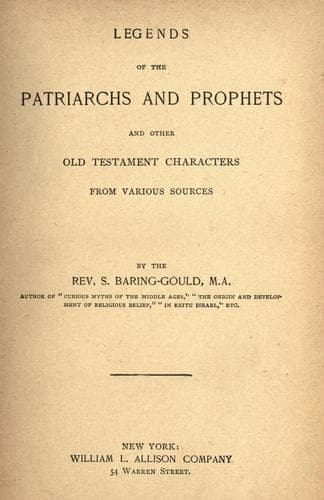
Legends of the Patriarchs and Prophets: And Other Old Testament Characters from Various SourcesBaring-Gould, S. (Sabine)
Religion
Legends of the Patriarchs and Prophets: And Other Old Testament Characters from Various Sources
Baring-Gould, S. (Sabine)
Bible. Old Testament -- Legends
To repel them, the Hebrews were summoned from the land of Goshen, but
the Egyptians would not receive their allies into the camp, fearing
lest they should unite with their kindred nations, and deliver them up
to destruction.
Zepho now asked Balaam, who had followed him, to divine the end of
the battle, but the attempt failed; and the future remained closed
to him. But Zepho, full of confidence, led the combined army against
the Egyptians, repulsed them at every point, and drove them back upon
the camp of the Hebrews. Then the Israelites charged the advancing
forces flushed with victory, who, little expecting such a determined
onslaught, were thrown into confusion, and routed with great loss.
The Hebrews pursued them to the confines of Ethiopia, cutting them
down all along the way, and then they desisted and returned: and on
numbering their band--they were but a handful--they found that they had
not lost one man. They now looked out for their allies, the Egyptians,
and found that they had deserted and fled; therefore, full of wrath,
they returned to Goshen in triumph, and slew the deserters, with many
words of contempt and ridicule.[454]
Thus the Hebrews were puffed up with pride, regarding themselves
as invincible; and the Egyptians were filled with dread, lest this
small people should resolve on seizing upon the supremacy, and should
subjugate them.
Therefore the reigning Pharaoh and his council assembled to consult
what should be done; and this was decided:--“The cities Pithom and
Rameses (Tanis and Heliopolis) are not strong enough to withstand a
foe, therefore they must be strengthened.” And a royal decree went
forth over all the land of Egypt and Goshen, commanding all the
inhabitants, both Egyptians and Hebrews, to build. Pharaoh himself set
the example by taking trowel and basket in hand, and putting a brick
mould on his neck. Whoever saw this hastened to do likewise, and all
who were reluctant were stimulated by the overseers with these words,
“See how the king works. Will you not imitate his activity?”
Thus the Israelites went to the work, and laid the mould upon their
necks, little suspecting the guile that was in the hearts of the king
and his councillors.
At the close of the first day, the Hebrews had made a large number of
bricks; and this number was now imposed upon them as the amount of
their daily task.
Thus passed a month, and by degrees the Egyptian workmen were
withdrawn, yet the Hebrews were paid the regular wage.
When a year and four months had elapsed, not an Egyptian was to be seen
making bricks and building; and the wage was stopped for the future,
but the Hebrews were kept to their work.
The harshest and most cruel men were appointed to be their overseers,
and if one of the Israelites asked for his wage, or fainted under his
burden, he was beaten or put in the stocks.
Public-domain text, read in full here on John Shaqi.
Reviews
Reviews
No reviews yet
Be the first to share your thoughts on this work.
Elsewhere in the archive
Join the Discussion
Join the discussion
Sign in to leave a comment or review.
Sign InorCreate an account