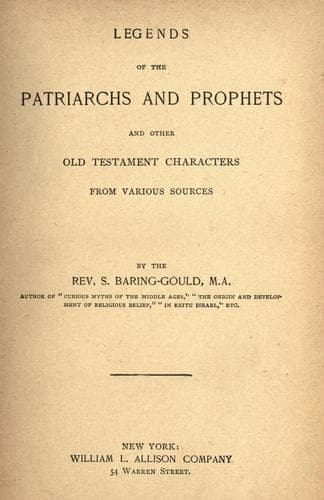
Legends of the Patriarchs and Prophets: And Other Old Testament Characters from Various SourcesBaring-Gould, S. (Sabine)
Religion
Legends of the Patriarchs and Prophets: And Other Old Testament Characters from Various Sources
Baring-Gould, S. (Sabine)
Bible. Old Testament -- Legends
When Pithom and Rameses were walled, the Israelites were employed to
strengthen with forts all the other cities of Egypt, then to build
storehouses and pyramids, to dig canals for the Nile, and to rear dykes
against the overflow. They were also employed to dig and plough the
fields, to garden and prune the fruit-trees, and to exercise trades.
They were engaged from early dawn till late at night, and because the
way from their homes was often far, they were forced to sleep in the
open air, upon the bare ground.[455]
As the life of the Israelites became embittered to them, they called
the king Meror, “the embitterer,” instead of Melol, “the grinder,”
though that was appropriate enough, one would have supposed.[456]
But matters grew worse; the Edomites and Hittites again threatened
Egypt, and Pharaoh ordered a closer guard to be kept, and heavier tasks
to be laid upon the Hebrews.
Notwithstanding all attempts to crush the spirit of this unfortunate
people and to diminish their numbers, they were sustained by hope in
God, for a voice was heard from heaven, “This people shall increase
abundantly, and multiply.”
Whilst the men of Israel slept exhausted after their unspeakable
oppression of mind and body, the faithful women labored to relieve and
strengthen them. They hastened to the springs to bring pure water to
their husbands to drink, and, by the mercy of the All Merciful, it fell
out that their pitchers were found, each time, to contain half water
and half fish.
These gentle and diligent women dressed the fish, and prepared other
good meats for their husbands, and they sought them at their work with
the food, and with their cheerful words of encouragement. This loving
attention of the women soothed the hearts of the men, and gave them
fresh energy.
When 125 years had elapsed since Jacob came into Egypt, the
fifty-fourth year after Joseph’s death, the elders and councillors of
Egypt presented themselves before Pharaoh, and complained to him that
the people increased and multiplied and became very great in the land,
so that they covered it like the bushes in the wood; and two of the
king’s councillors, of whom one was Job of Uz, said to Pharaoh, “It
was well that heavy tasks were laid upon the Hebrews, but that doth
not suffice; it is needful that they should be diminished in number as
well as enslaved. Therefore give orders to the nurses to kill every
male child that is born to the Hebrews, but to save the women children
alive.”
This council pleased the king well; and what Job had advised was put in
operation.
Public-domain text, read in full here on John Shaqi.
Reviews
Reviews
No reviews yet
Be the first to share your thoughts on this work.
Elsewhere in the archive
Join the Discussion
Join the discussion
Sign in to leave a comment or review.
Sign InorCreate an account