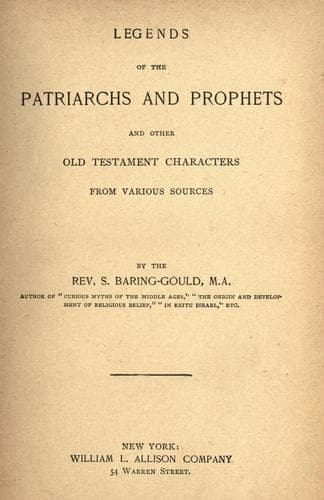
Legends of the Patriarchs and Prophets: And Other Old Testament Characters from Various SourcesBaring-Gould, S. (Sabine)
Religion
Legends of the Patriarchs and Prophets: And Other Old Testament Characters from Various Sources
Baring-Gould, S. (Sabine)
Bible. Old Testament -- Legends
At this time God had sent upon Egypt an intolerable heat, and the
people were affected with grievous boils.[468] To cure themselves, they
bathed in the Nile. Bithia also suffered, and bathed, not in the river,
but in baths in the palace; but on this day she went forth by the Nile
bank, though otherwise she never left her father’s palace. On reaching
the bathing-place she observed the ark lodged among the bulrushes, and
sent one of her maids to swim out and bring it to her; but the other
servants said, “O princess, this is one of the Hebrew children, who are
cast out according to the command of thy royal father. It beseems thee
not to oppose his commands and frustrate his will.”
Scarcely had the maidens uttered these words than they vanished from
the surface of the earth. The angel Gabriel had sunk them all, with the
exception of the one who swam for the ark, into the bosom of the earth.
But the eagerness of the princess was so great, that she could not wait
till the damsel brought her the basket, and she stretched forth her arm
towards it, and her arm was lengthened sixty ells, so that she was able
to take hold of the ark and draw it to land, and lift the child out of
the water.
No sooner had she touched the babe, than she was healed of the boils
which afflicted her, and the splendor of the face of the child was
like that of the sun.[469] She looked at it with wonder, and admired
its beauty. But her father’s stern law made her fear, and she thought
to return the child to the water, when he began to cry, for the angel
Gabriel had boxed his ears to make him weep, and thus excite the
compassion of the princess. Then Miriam, hid away among the rushes, and
little Aaron, aged three, hearing him cry, wept also.
The heart of the princess was stirred; and compassion, like that of a
mother for her babe, filled her heart. She felt for the infant yearning
love as though it were her own. “Truly,” said Bithia, “the Hebrews are
to be pitied, for it is no easy matter to part with a child, and to
deliver it over to death.”
Then, fearing that there would be no safety for the babe, if it were
brought into the palace, she called to an Egyptian woman who was
walking by the water, and bade her suckle the child. But the infant
would not take the breast from this woman, nor from any other Egyptian
woman that she summoned; and this the Almighty wrought that the child
might be restored to its own mother again.
Then Miriam, the sister, mingled with those who came up, and said to
Bithia, with sobs, “Noble lady! vain are all thine attempts to give
the child the breast from one of a different race. If thou wouldst
have a Hebrew woman, then let me fetch one, and the child will suck at
once.”[470]
This advice pleased Bithia, and she bade Miriam seek her out a Hebrew
mother.
With winged steps Miriam hastened home, and brought her mother,
Jochebed, to the princess. Then the babe readily took nourishment from
her, and ceased crying.
Public-domain text, read in full here on John Shaqi.
Reviews
Reviews
No reviews yet
Be the first to share your thoughts on this work.
Elsewhere in the archive
Join the Discussion
Join the discussion
Sign in to leave a comment or review.
Sign InorCreate an account