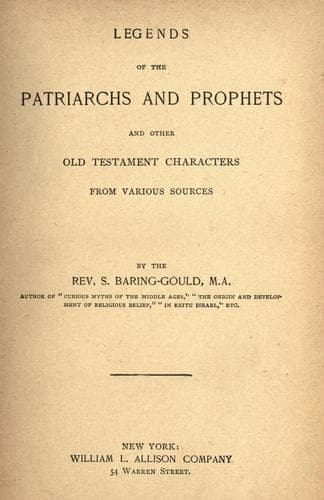
Legends of the Patriarchs and Prophets: And Other Old Testament Characters from Various SourcesBaring-Gould, S. (Sabine)
Religion
Legends of the Patriarchs and Prophets: And Other Old Testament Characters from Various Sources
Baring-Gould, S. (Sabine)
Bible. Old Testament -- Legends
Astonished at this wonder, the king’s daughter said, but unawares, the
truth, for she spake to Jochebed, “Here is thy child; take and nurse
the child for me, and the wage shall be two pieces of silver a day.”
Jochebed did what she was bidden, but better reward than all the silver
in Pharaoh’s house was the joy of having her son restored to his
mother’s breast.
The self-same day the soothsayers and star-gazers said to Pharaoh, “The
child of whom we spake to thee, that he should free Israel, hath met
his fate in the water.”
Therefore the cruel decree ordering the destruction of all male infants
was withdrawn, and the miraculous deliverance of Moses became by this
means the salvation of the whole generation. In allusion to this, Moses
said afterwards to the people when he would restrain them (Numbers
xi.): “Verily ye number six hundred thousand men, and ye would all
have perished in the river Nile, but I was delivered from the water,
and therefore ye are all alive as at this day.”
After two years Jochebed weaned him, and brought him to the king’s
daughter. Bithia, charmed with the beauty and intelligence of the
child, took him into the palace, and named him Moses (he who is drawn
out of the water). Lo! a voice from heaven fell, “Daughter of Pharaoh!
because thou hast had compassion on this little child and hast called
him thy son, therefore do I call thee My daughter (Bithia). The
foundling that thou cherishest shall be called by the name thou gavest
him--Moses; and by none other name shall he be known, wheresoever the
fame of him spreads under the whole heaven.”
Now, in order that Moses might really pass for the child of Bithia, the
princess had feigned herself to be pregnant, and then to be confined;
and now Pharaoh regarded him as his true grandchild.
On account of his exceeding beauty, every one that saw him was filled
with admiration, and said, “Truly, this is a king’s son.” And when he
was taken abroad, the people forsook their work, and deserted their
shops, that they might see him. One day, when Moses was three years
old, Bithia led him by the hand into the presence of Pharaoh, and the
queen sat by the king, and all the princes of the realm stood about
him. Then Bithia presented the child to the king, and said, “Oh, sire!
this child of noble mien is not really my son; he was given to me in
wondrous fashion by the divine river Nile; therefore have I brought him
up as my own son, and destined him to succeed thee on thy throne, since
no child of my body has been granted to me.”
With these words Bithia laid the boy in the king’s arms, and he pressed
him to his heart, and kissed him. Then, to gratify his daughter, he
took from his head the crown royal, and placed it upon the temples of
Moses. But the child eagerly caught at the crown, and threw it on the
ground and then alighting from Pharaoh’s knee, he in childish fashion
danced round it, and finally trampled it under his feet.[471]
Public-domain text, read in full here on John Shaqi.
Reviews
Reviews
No reviews yet
Be the first to share your thoughts on this work.
Elsewhere in the archive
Join the Discussion
Join the discussion
Sign in to leave a comment or review.
Sign InorCreate an account