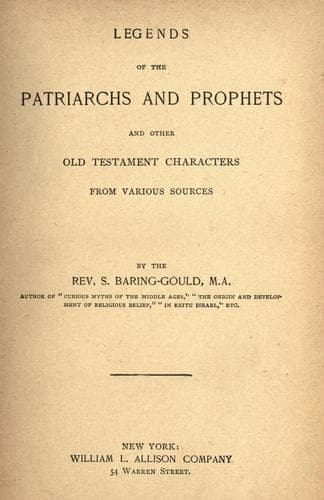
Legends of the Patriarchs and Prophets: And Other Old Testament Characters from Various SourcesBaring-Gould, S. (Sabine)
Religion
Legends of the Patriarchs and Prophets: And Other Old Testament Characters from Various Sources
Baring-Gould, S. (Sabine)
Bible. Old Testament -- Legends
With regard to Jewish traditions, it is unfortunate that both
Eisenmenger and Bartolocci, who collected many of them, were so
prejudiced, so moved with violent animosity against the Rabbinic
writers, that they preserved only the grotesque, absurd, and
indecent legends, and wholly passed over those--and there are many of
them--which are redolent of poetry, and which contain an element of
truth.
* * * * *
A certain curious interest attaches to these legends--at least, I think
so; and, should they find favor with the public, this volume will
be followed by another series on the legends connected with the New
Testament characters.
The author is not aware of any existing collection of these legends,
except that of M. Colin de Plancy, “Legendes de l’Ancien Testament,”
Paris, 1861; but he has found this work of little or no use to him
in composing his volume, as M. de Plancy gives no reference to
authorities; and also, because nearly the whole of the contents
are taken from D’Herbelot’s “Bibliothèque Orientale” and Migne’s
“Dictionnaire des Apocryphes.”
It will be necessary to add a few words on certain works largely quoted
in the following pages.
1. Dr. G. Weil’s “Biblische Legende der Muselmänner,” Frankfurt a. M.,
1845, is derived from three Arabic MS. works--“_Chamis_,” by Husein
Ibn Mohammed Ibn Alhasan Addiarbekri; “_Dsachirat Alulun wanatidjat
Alfuhum_,” by Ahmed Ibn zein Alabidin Albekri; and “_Kissat Alanbija_,”
by Mohammed Ibn Ahmed Alkissai.
2. The Chronicle of Abou-djafar Mohammed Tabari was translated into
Persian by Abou Ali Mohammed Belami, who added sundry traditions
circulating in Persia; and has been rendered into French, in part, by
M. Hermann Zolenberg, for the Oriental Translation Fund, Paris, 1867.
3. The “Sepher Hajaschar,” or Book of Jasher (Yaschar), is quoted from
the translation by Le Chevalier P. L. B. Drach, inserted in Migne’s
“Dictionnaire des Apocryphes.”
4. Eisenmenger, “Neuentdektes Judenthum,” 2 vols. 8vo, Königsburg,
1711, contains a great many Rabbinic traditions collected from sources
inaccessible to most persons.
5. Bartolocci, “Bibliotheca Magna Rabbinica,” 4 vols. fol., Rome,
1675-93, is a very valuable storehouse of information, but sadly
disfigured by prejudice.
CONTENTS.
PAGE.
PREFACE v
I.
THE FALL OF THE ANGELS 15
II.
ADAM 21
1. The Creation of Man 21
2. The Pre-Adamites 27
III.
EVE 29
IV.
THE FALL OF MAN 36
V.
Public-domain text, read in full here on John Shaqi.
Reviews
Reviews
No reviews yet
Be the first to share your thoughts on this work.
Join the Discussion
Join the discussion
Sign in to leave a comment or review.
Sign InorCreate an account