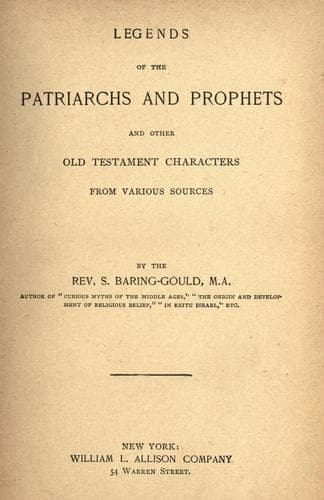
Legends of the Patriarchs and Prophets: And Other Old Testament Characters from Various SourcesBaring-Gould, S. (Sabine)
Religion
Legends of the Patriarchs and Prophets: And Other Old Testament Characters from Various Sources
Baring-Gould, S. (Sabine)
Bible. Old Testament -- Legends
But Moses kept ever before his eyes the aim of his life, to relieve his
people from their intolerable burdens. One day he presented himself
before the king and said, “Sire! I have a petition to make of thee.”
Pharaoh answered, “Say on, my son.”
Then said Moses, “O king! every laborer is given one day in seven for
rest, otherwise his work becomes languid and unprofitable. But the
children of Israel are given no day of rest, but they work from the
first day of the week to the last day, without cessation; therefore
is their work inferior, and it is not executed with that heartiness
which might be found, were they given one day in which to recruit their
strength.”
Pharaoh said, “Which day shall be given to them?”
Moses said, “Suffer them to rest on the seventh day.”
The king consented, and the people were given the Sabbath, on which
they ceased from their labors; therefore they rejoiced greatly, and
for a thousand years the last day of the week was called “The gift of
Moses.”[476]
As the command to destroy all the male children had been withdrawn
the day that Moses was cast into the Nile, the people had multiplied
greatly, and again the fears of the Egyptians were aroused. Therefore
the king published a new decree, with the object of impeding the
increase of the bondsmen.
He required the Egyptian task-masters to impose a tale of bricks on
every man, and if at evening the tale of bricks was not made up, then,
in place of the deficient bricks, even though only one brick was short,
they were to take the children of those who had not made up their tale,
and to build them into the wall in place of bricks.[477] Thus upon one
misery another was piled.
In order that this decree might be executed with greater certainty,
ten laborers were placed under one Hebrew overseer, and one Egyptian
task-master controlled the ten overseers. The duty of the Hebrew
overseers was to wake the ten men they were set over, every morning
before dawn, and bring them to their work. If the Egyptian task-masters
observed that one of the laborers was not at his post, he went to the
overseer, and bade him produce the man immediately.
Now one of these overseers had a wife of the tribe of Dan, whose name
was Salome, daughter of Dibri. She was beautiful and faultless in her
body. The Egyptian task-master had observed her frequently, and he
loved her. Then, one day, he went early to the house of her husband,
and bade him arise, and go and call the ten laborers. So the overseer
rose, nothing doubting, and went forth, and then the Egyptian entered
and concealed himself in the house. But the overseer returning, found
him, and drew him forth, and asked him with what intent he had hidden
himself there; and Moses drew nigh. Now Moses was known to the Hebrews
as merciful, and ready to judge righteously their causes; so the man
ran to Moses, and told him that he had found the Egyptian task-master
concealed in his house.
Public-domain text, read in full here on John Shaqi.
Reviews
Reviews
No reviews yet
Be the first to share your thoughts on this work.
Elsewhere in the archive
Join the Discussion
Join the discussion
Sign in to leave a comment or review.
Sign InorCreate an account