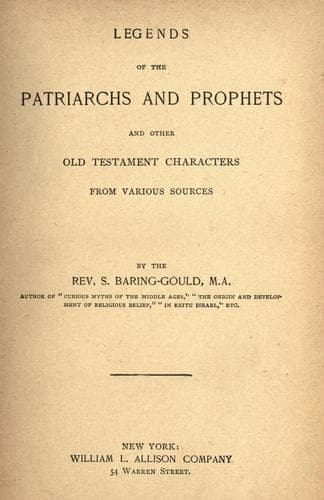
Legends of the Patriarchs and Prophets: And Other Old Testament Characters from Various SourcesBaring-Gould, S. (Sabine)
Religion
Legends of the Patriarchs and Prophets: And Other Old Testament Characters from Various Sources
Baring-Gould, S. (Sabine)
Bible. Old Testament -- Legends
Masters were brought for him from all quarters, and he was instructed
in all the wisdom and learning of the Egyptians; and the people looked
upon him with hope as their future sovereign.[474]
3. THE YOUTH AND MARRIAGE OF MOSES.
Moses, as he grew older, distinguished himself from all other young
men of Egypt by the conquest which he acquired over himself and his
youthful passions and impetuous will. Although the life of a court
offered him every kind of gratification, yet he did not allow himself
to be attracted by its pleasures, or to regard as permanent what
he knew to be fleeting. Thus it fell out, that all his friends and
acquaintances wondered at him, and doubted whether he were not a god
appeared on earth. And, in truth, Moses did not live and act as did
others. What he thought, that he said, and what he promised, that he
fulfilled.
Moses had reached the summit of earthly greatness; acknowledged as
grandson to Pharaoh, and heir to the crown. But he trusted not in the
future which was thus offered to him, for he knew from Jochebed, whom
he frequently visited, what was his true people, and who were his real
parents. And the bond which attached him to his own house and people
was in his heart, and could not be broken.
Moses went daily to Goshen to see his relations; and he observed how
the Hebrews were oppressed, and groaned under their burdens. And he
asked wherefore the yoke was pressed so heavily on the neck of these
slaves. He was told of the advice of Balaam against the people, and of
the way in which Pharaoh had sought the destruction of himself in his
infancy. This information filled Moses with indignation, and alienated
his affections from Pharoah, and filled him with animosity towards
Balaam.[475] But, as he was not in a position to rescue his brethren,
or to punish Balaam, he cried, “Alas! I had rather die than continue to
behold the affliction of my brethren.” Then he took the necklace from
off him, which indicated his princely position, and sought to ease the
burden of the Israelites. He took the excessive loads from the women
and old men, and laid them on the young and strong; and thus he seemed
to be fulfilling Pharaoh’s intentions in getting the work of building
sooner executed, whereas, by making each labor according to his
strength, their sufferings were lightened. And he said to the Hebrews,
“Be of good cheer, relief is not so far off as you suppose--calm
follows storm, blue sky succeeds black clouds, sunshine comes after
rain. The whole world is full of change, and all is for an object.”
Nevertheless Moses himself desponded; he looked with hatred upon
Balaam, and lost all pleasure in the society of the Egyptians. Balaam
seeing that the young man was against him, and dreading his power,
escaped with his sons Jannes and Jambres to the court of Ethiopia.
The young Moses, however, grew in favor with the king, who laid upon
him the great office of introducing illustrious foreigners to the royal
presence.
Public-domain text, read in full here on John Shaqi.
Reviews
Reviews
No reviews yet
Be the first to share your thoughts on this work.
Elsewhere in the archive
Join the Discussion
Join the discussion
Sign in to leave a comment or review.
Sign InorCreate an account