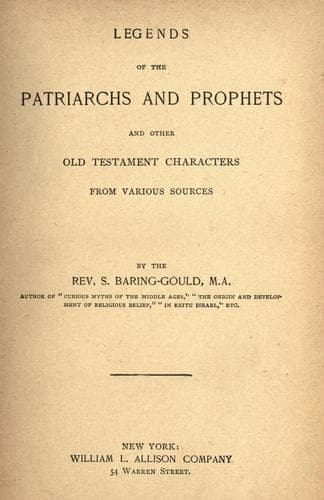
Legends of the Patriarchs and Prophets: And Other Old Testament Characters from Various SourcesBaring-Gould, S. (Sabine)
Religion
Legends of the Patriarchs and Prophets: And Other Old Testament Characters from Various Sources
Baring-Gould, S. (Sabine)
Bible. Old Testament -- Legends
But there were some ungodly men who disobeyed the voice of Joshua, and
when they passed through the gates, they did not prostrate themselves,
but they raised their heads to heaven, and instead of saying
“_hittaton_,” as commanded, they said “_hintaton_,” asking for corn.
Then the wrath of God was kindled against these men, and fire fell
from heaven, and consumed all that had said _hintaton_ in place of
_hittaton_.[588]
Near Ai there were mountains, in which reigned two kings, Kuma and
Djion (Sihon). These Amorites were wealthy. When Joshua attacked these
kings, they asked to make a league with the people of Israel; and they
were accepted, on condition that they believed in the religion of Moses.
Another of these mountain kingdoms was governed by a king called Barak
(Adoni-bezek). He also sought by submission to escape ruin, and Joshua
accepted him on the same terms as Kuma and Djion.
To the west were five cities, whose inhabitants were also Amorites. The
kings of these cities made war on Joshua. Joshua routed them, and these
five kings took refuge in a cave. Joshua ordered the cave to be closed
with a stone, whilst he pursued the routed army. Then God sent hail
from heaven, and each hailstone struck down and killed a man.[589]
On that day Joshua cried to the Lord, for the sun hastened to go
down, and it was a Friday, and he feared that he should not have
utterly discomfited the host before the Sabbath came in. Then the
Lord lengthened the day one hour, so as to enable him to complete his
victory.[590]
After the battle, it was announced to him that Barak and the other
kings who had made submission to him had taken advantage of the rising
of the kings of the five cities to renounce their allegiance, and to
return to the worship of false gods. Therefore Joshua prayed, “O Lord!
because they have become unfaithful, take from them their riches, and
make them poor, that they may become bondsmen; and that their king may
fall into misery!”
Joshua was sick and unable to march against them. He was aged a hundred
and twenty-eight years. He was a hundred years old when Moses died, and
he governed Israel twenty-eight years.[591]
For the benefit of coin-collectors, the following information is
inserted. “On the coins struck by Abraham are figured, on the obverse,
an old man and an ass; on the reverse, a boy and a girl. On the coins
of Joshua are, on one side a bull, on the other a unicorn. On those of
David, on one side a staff and wallet, on the other a tower. On those
of Mordecai, on the obverse, sackcloth and ashes; and on the reverse a
crown.”[592]
After Joshua, Caleb, the son of Jephunneh, and Othniel, the son of
Kenaz,[593] Caleb’s brother, governed Israel. They collected the
people, and marched against Barak (Adoni-bezek)[594] and his people who
had apostatized, and attacked them, and slew great numbers of them.
Public-domain text, read in full here on John Shaqi.
Reviews
Reviews
No reviews yet
Be the first to share your thoughts on this work.
Elsewhere in the archive
Join the Discussion
Join the discussion
Sign in to leave a comment or review.
Sign InorCreate an account