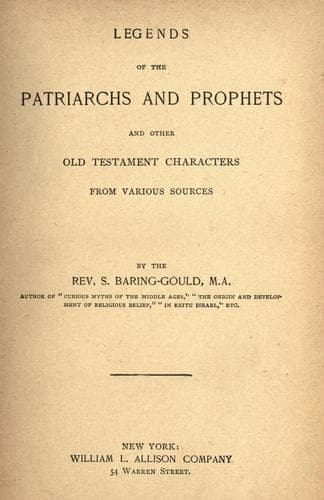
Legends of the Patriarchs and Prophets: And Other Old Testament Characters from Various SourcesBaring-Gould, S. (Sabine)
Religion
Legends of the Patriarchs and Prophets: And Other Old Testament Characters from Various Sources
Baring-Gould, S. (Sabine)
Bible. Old Testament -- Legends
They took the king and cut off his thumbs. This Barak had, during his
reign, treated seventy kings in like fashion, so that they were unable
to pick up any thing off the ground. And when Barak was feasting, these
kings were brought before him. Then he cast bread among them, but they
were unable to pick it up, having no thumbs, and they were obliged to
stoop to the ground, and take it in their mouths like dogs; and this
caused huge merriment to the king.[595]
XXXIV.
THE JUDGES.
If Joshua, the first of the Judges, has, to a great extent, escaped the
hands of legend manufacturers, the same may be said of his successors,
Phinehas, Othniel, Ehud, Deborah and Barak, Gibeon, Abimelech, Tola,
Jair, Jephthah, Ibzan, Elon, and Abdon. Even Samson has not been
surrounded by such a multitude of traditions as might have been
expected.
The Mussulmans have little to say of him, and the Jewish legends are
not numerous.
The Rabbi Samuel, son of Nahaman, said that Samson once took two
mountains, one in each hand, and knocked them together, as a man will
strike together two pebbles. The Rabbi Jehuda said that when the
Spirit of the Lord rested on him he strode in one stride from Zorah to
Eshtaol. The Rabbi Nahaman added that his hair stood up, and one hair
tinkled against another, so that the sound could be heard, like that of
bells, from Zorah to Eshtaol.[596]
Abulfaraj says that Phinehas, the son of Eleazer, the son of Aaron,
after the death of Joshua, was commanded by an angel to put the manna,
the rods, the tables of the covenant, and the five books of Moses in
a brazen urn, seal it with lead, and conceal it in a cave, as the
Israelites were too wicked to be entrusted with such a treasure.[597]
XXXV.
SAMUEL.
Gjalout (Goliath) was king of the Philistines. He was of the race of
the ancient giants, the Adites and the Themudites, who were from fifty
to a hundred cubits in height.
The children of Israel were grievously oppressed by him, and they
besought God to send them a prophet who would reinstruct them in
the law of Moses, and in the true religion. For thirty years they
besought God, but no prophet was given to them. In the meanwhile, the
Philistines oppressed them more and more, and whenever the Israelites
rose against them they defeated the Israelites with great slaughter.
There died a man of the tribe of Levi, Rayyan (Elkanah), son of Elkama,
who was descended from Aaron the brother of Moses. The elders of Israel
hearing that he had died, leaving his wife pregnant, went to her and
surrounded her with the greatest care and comforts.
There was amongst them a wise man named Hil (Eli) who was high-priest;
to him they confided the care of the widow. In time she bore a son, who
was named Ischmawil (Samuel).
Eli brought up the child Samuel in the temple, to the age of seven
years, and he taught him the Pentateuch and the religion of Moses.
Public-domain text, read in full here on John Shaqi.
Reviews
Reviews
No reviews yet
Be the first to share your thoughts on this work.
Elsewhere in the archive
Join the Discussion
Join the discussion
Sign in to leave a comment or review.
Sign InorCreate an account