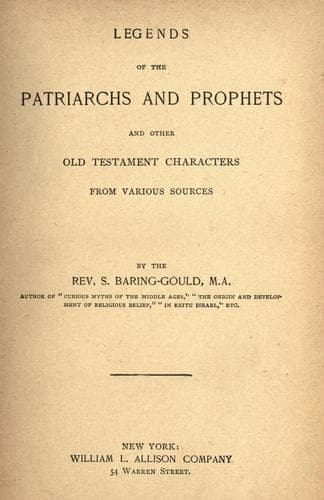
Legends of the Patriarchs and Prophets: And Other Old Testament Characters from Various SourcesBaring-Gould, S. (Sabine)
Religion
Legends of the Patriarchs and Prophets: And Other Old Testament Characters from Various Sources
Baring-Gould, S. (Sabine)
Bible. Old Testament -- Legends
Samuel regarded Eli as his father, because he had been brought up by
him, and he loved and reverenced him greatly.
One night when he was asleep, Gabriel came into the room and made a
noise, so that Samuel awoke.
He saw no one, so he called to Eli, “Master! didst thou summon me?”
Eli replied, “No, my son, I did not summon thee.”
Next night the same occurred; so also the third night.
Then Eli thought that God wished to give to Samuel the gift of
prophecy; therefore he said, “My son, if thou art called again in the
night, reply, Here am I; what wouldest Thou? I am in Thy hands.”
Samuel did so. Then Gabriel appeared to him and communicated to him the
message of God.
Samuel told Eli that the Lord had given him the gift of prophecy, by
the mouth of His messenger Gabriel.
Then Eli was rejoiced, and he announced the glad tidings to all Israel.
Eli had two sons whom he had instructed in the art of offering
sacrifice according to the law of Moses, but he had taught them nothing
else. Eli himself moreover neglected to sacrifice, and he allowed
his sons to live after their lusts, unrestrained by his paternal and
priestly rebuke.
Therefore God spake to Samuel that He would punish Eli and his sons;
but Samuel feared to show it to the high priest.
Then said Eli to him, “Has God given thee a message to me?”
And Samuel answered, “God has said, Why hast thou neglected to offer
sacrifice, so that thy sons add thereto or detract therefrom? And why
hast thou not constrained them? Because of this sin, I shall deliver
thee into the hands of an enemy, who shall slay thy sons, and take the
ark, and cause thee to perish also.”[598]
Then Gjalout came, and made war against the children of Israel, and
there was a great battle, and Hophni and Phinehas, the sons of Eli,
were slain, and the ark was taken; and Eli fell backward from off his
seat when he heard the news, and his neck brake, and he died.
In the ark, that now fell into the hands of the Philistines, were
preserved the tables of the Law, which God had given to Moses, and
a basin in which the angels washed and purified the hearts of the
prophets, and the mitre and breastplate and potificial robes of Aaron.
The Israelites had been accustomed, in times of peril, to produce the
ark, and it had delivered them from evil by virtue of the sacred relics
it contained. As for the Shekinah which rested upon it, and from which
the ark took its name of Tabut-Shekinah, the Mussulman authors assure
us it had the form of a leopard, which, whenever the ark was carried
against the enemies of God’s people, rose on its legs, and uttered
so potent a roar, that the foes of Israel fell to the ground. These
authors, however, derive this fable from Rabbinic writers.[599]
The king of the Philistines, having obtained possession of the ark,
placed it in a draught-house, purposing thereby to express his hatred
of the Jews, and his contempt for that which they regarded as most
sacred.
Public-domain text, read in full here on John Shaqi.
Reviews
Reviews
No reviews yet
Be the first to share your thoughts on this work.
Elsewhere in the archive
Join the Discussion
Join the discussion
Sign in to leave a comment or review.
Sign InorCreate an account