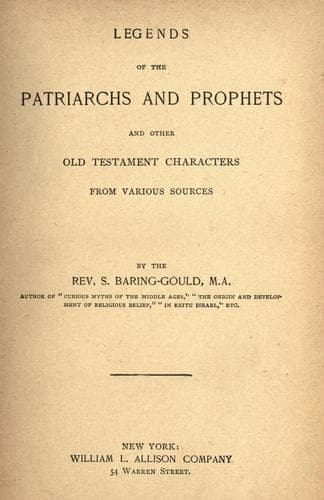
Legends of the Patriarchs and Prophets: And Other Old Testament Characters from Various SourcesBaring-Gould, S. (Sabine)
Religion
Legends of the Patriarchs and Prophets: And Other Old Testament Characters from Various Sources
Baring-Gould, S. (Sabine)
Bible. Old Testament -- Legends
A curious legend exists among the Sclavonic nations by which the
existence of elves is accounted for. It is said that Adam had by his
wife Eve, thirty sons and thirty daughters. God asked him, one day, the
number of his children. Adam was ashamed of having so many girls, so he
answered, “Thirty sons and twenty-seven daughters.” But from the eye of
God nothing can be concealed, and He took from among Adam’s daughters
the three fairest, and He made them Willis, or elves; they were good
and holy, and therefore did not perish in the Deluge, but entered with
Noah into the ark and were saved.
The story of Adam’s penitence, as told by Tabari, is as follows:--
The moment that Adam fell out of Paradise and touched the ground on the
mountains in the centre of Ceylon, he understood in all its magnitude
the greatness of his loss and his sin. He remained stupefied with his
face on the earth, and did not raise it, but allowed his tears to flow
upon and soak into the soil. For a hundred years he remained in this
position, and his tears formed a stream which rolled down the mountain,
which still flows from Adam’s Peak in the island of Ceylon, and gives
their virtue to the healing plants and fragrant trees which there
flourish, and are exported for medicinal purposes.
When a hundred years had elapsed, God had compassion on Adam, and sent
Gabriel to him, who said, “God salutes thee, O Adam! and He bids me say
to thee, Did I not create thee out of the earth by My will? Did I not
give thee Paradise to be thine abode? Why these tears and sighs?”
Adam replied, “How shall I not weep, and how shall I abstain from
sighing? Have I not lost the protection of God, and have I not
disobeyed His will?”
Gabriel said, “Do not afflict thyself. Recite the words I shall teach
thee, and God will grant thee repentance which He will accept,” as it
is written in the Koran, “Adam learnt of His Lord words; and the Lord
returned to Him, for He is merciful, and He returns.” Adam recited
these words, and in the joy he felt at the prospect of finding mercy,
he wept, and his joyous tears watered the earth, and from them sprang
up the narcissus and the ox-eye.
Then said Adam to Gabriel, “What shall I now do?”
And Gabriel gave to Adam wheat-grains from out of Paradise, the fruit
of the Forbidden Tree, and he bade him sow it, and he said, “This shall
be thy food in future.”
Afterwards, Gabriel taught Adam to draw iron out of the rock and to
make instruments of husbandry. And all that Adam sowed sprang up in the
self-same hour that it was sown, for the blessing of God was upon it.
And Adam reaped and thrashed and winnowed. Then Gabriel bade him take
two stones from the mountain, and he taught him with them to grind the
corn; and when he had made flour, he said to the angel, “Shall I eat
now?” But Gabriel answered, “Not so;” and he showed him how to build
an oven of iron. It was from this oven that the water of the deluge at
Koufa flowed. He taught him also to make dough and to bake.
Public-domain text, read in full here on John Shaqi.
Reviews
Reviews
No reviews yet
Be the first to share your thoughts on this work.
Join the Discussion
Join the discussion
Sign in to leave a comment or review.
Sign InorCreate an account