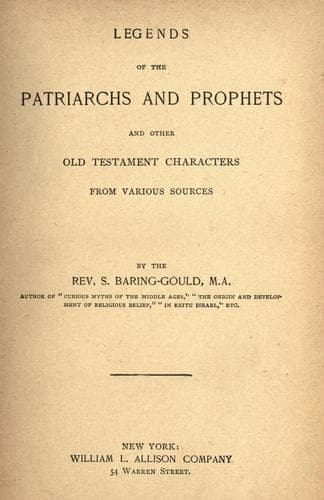
Legends of the Patriarchs and Prophets: And Other Old Testament Characters from Various Sources — John Shaqi
Legends of the Patriarchs and Prophets: And Other Old Testament Characters from Various SourcesBaring-Gould, S. (Sabine)
Religion
Legends of the Patriarchs and Prophets: And Other Old Testament Characters from Various Sources
Baring-Gould, S. (Sabine)
Bible. Old Testament -- Legends
ELIJAH 371
XL.
ISAIAH 373
XLI.
JEREMIAH 376
XLII.
EZEKIEL 377
XLIII.
EZRA 377
XLIV.
ZACHARIAH 380
LEGENDS OF THE PATRIARCHS AND PROPHETS.
I.
THE FALL OF THE ANGELS.
In the beginning, before the creation of heaven and earth, God made
the angels; free intelligences and free wills; out of His love He made
them, that they might be eternally happy. And that their happiness
might be complete, He gave them the perfection of a created nature;
that is, He gave them freedom.
But happiness is only attained by the free will agreeing in its freedom
to accord with the will of God. Some of the angels by an act of free
will obeyed the will of God, and in such obedience found perfect
happiness; other angels by an act of free will rebelled against the
will of God, and in such disobedience found misery.
Such is the catholic theory of the fall of the angels.
Historically, it is represented as a war in heaven. “_And there was
war in heaven: Michael and his angels fought against the dragon; and
the dragon fought and his angels, and prevailed not; neither was their
place found any more in heaven. And the great dragon was cast out,
that old serpent, called the Devil, and Satan, which deceiveth the
whole world; he was cast out into the earth, and his angels were cast
out with him._”[1] The reason of the revolt was that Satan desired to
be as great as God. “_Thou hast said in thine heart, I will ascend
into heaven, I will exalt my throne above the stars of God; I will sit
also upon the mount of the congregation in the sides of the north; I
will ascend above the heights of the clouds; I will be like the Most
High._”[2]
The war ended in the fall of Satan and those whom he had led into
apostasy; and to this fall are referred the words of Christ, “_I saw
Satan like lightning fall from heaven._”[3]
Fabricius, in his collections of the apocryphal writings of the Old
Testament, has preserved the song of triumph which the Archangel
Michael sang on obtaining the victory. This is a portion of it:--
Public-domain text, read in full here on John Shaqi.
Reviews
Reviews
No reviews yet
Be the first to share your thoughts on this work.
Join the Discussion
Join the discussion
Sign in to leave a comment or review.
Sign InorCreate an account