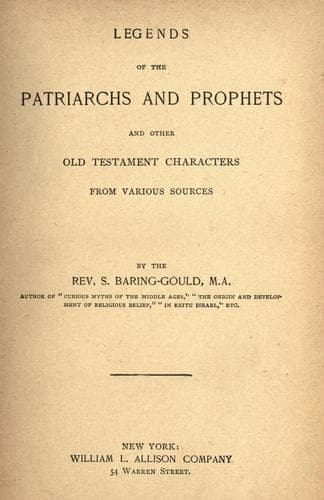
Legends of the Patriarchs and Prophets: And Other Old Testament Characters from Various SourcesBaring-Gould, S. (Sabine)
Religion
Legends of the Patriarchs and Prophets: And Other Old Testament Characters from Various Sources
Baring-Gould, S. (Sabine)
Bible. Old Testament -- Legends
As the fall of Satan took place through his aspiration to be God, so it
is closely connected with the origin of idolatry and false worship; for
now that Satan is cast out of heaven, he still seeks to exalt himself
into the place of God, and therefore leads men from the worship of the
true God into demonolatry. Thus the gods of the heathens were regarded
by the first Christians as devils aspiring to receive that worship
from men on earth which they sought and failed to obtain in heaven.
Thus St. Paul tells the Corinthians that “_the Gentiles sacrifice to
devils_.”[13] The temptation of Christ can only be fully understood
when we bear in mind that pride and craving for worship is the prime
source of Satan’s actions. “_All these will I give thee_,” he said to
Christ, “_if Thou wilt fall down and worship me._” It was a second
attempt of Satan to set himself above the Most High.
Among the heathen, traditions of the Angelic apostasy and war have
remained.
The Indian story is as follows:--
At the head of the apostate spirits is Mahisasura, or the great Asur;
he and those who followed him were once good, but before the creation
of the world they refused obedience to Brahma, wherefore they were
cast down by the assistance of Schiva into the abyss of Onderah.[14]
Mahisasura is also represented as the great serpent Vrita, against
which Indra fought, and which after a desperate struggle he overcame.
The Persian tradition is that Ahriman, the chief of the rebels, is not
by nature evil. He was not created evil by the Eternal One, but he
became evil by revolting against his will; and the ancient books of the
Parsees assert that at the last day Ahriman will return to obedience,
and having been purified by fire, will regain the place among the
heavenly beings which he lost. In this war the Izeds fought against the
Divs, headed by Ahriman, and flung the conquered into Douzahk or hell.
The Norse story is that Loki, the spirit of evil, is one of the gods,
and sat with them at their table till he declared himself their enemy,
when he with his vile progeny, the wolf and the serpent, were cast out.
The wolf is bound, Thorr constrains the serpent, and Loki is chained
under the mountains, and a serpent distils poison on his breast; when
he tosses in agony, the earth quakes.
In Egypt, Typhon was brother of Osiris, but he revolted against him.
Public-domain text, read in full here on John Shaqi.
Reviews
Reviews
No reviews yet
Be the first to share your thoughts on this work.
Join the Discussion
Join the discussion
Sign in to leave a comment or review.
Sign InorCreate an account