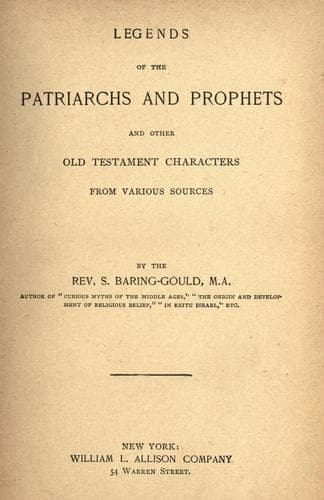
Legends of the Patriarchs and Prophets: And Other Old Testament Characters from Various SourcesBaring-Gould, S. (Sabine)
Religion
Legends of the Patriarchs and Prophets: And Other Old Testament Characters from Various Sources
Baring-Gould, S. (Sabine)
Bible. Old Testament -- Legends
The ancient Indian tradition is, “that in the reign of the sun-born
monarch Satyavrata, the whole earth was drowned, and the whole human
race destroyed by a flood, except the pious prince himself, the
seven Rishis and their several wives.” This general _pralaya_, or
destruction, is the subject of the first Purana, or sacred poem; and
the story is concisely told in the eighth book of the Bhagavata, from
which the following is an abridged extract:--“The demon Hayagriva
having purloined the Vedas from Brahma while he was reposing, the whole
race of man became corrupt, except the seven Rishis and Satyavrata.
This prince was performing his ablutions in the river Critamala, when
Vishnu appeared to him in the shape of a small fish, and after several
augmentations of bulk in different waters, was placed by Satyavrata in
the ocean, when he thus addressed his amazed votary:--‘In seven days
all creatures who have offended me shall be destroyed by a deluge;
but thou shalt be secured in a capacious vessel miraculously formed.
Take, therefore, all kinds of medicinal herbs and esculent grain for
food, and together with the seven holy men, your respective wives,
and pairs of all animals, enter the ark without fear; then shalt thou
know God face to face, and all thy questions shall be answered.’
Saying this, he disappeared; and, after seven days, the ocean began to
overflow the coasts, and the earth to be flooded by constant showers,
when Satyavrata, meditating on the Deity, saw a large vessel moving
on the waters: he entered it, having in all respects conformed to the
instructions of Vishnu, who, in the form of a large fish, suffered
the vessel to be tied with a great sea-serpent, as with a cable, to
his measureless horn. When the deluge had ceased, Vishnu slew the
demon and recovered the Vedas, and instructed Satyavrata in divine
knowledge.”[217]
The Mahabharata says that the boat containing Manu and his seven
companions rested on Mount Naubhandanam, the highest peak of the
Himalayas; and the name Naubhandanam signifies “ships stranding.”[218]
The Greek traditions are not early, and were probably borrowed from
Semitic sources. We have seen the story told by Lucian in his book
“De Dea Syra,” but in his “Timon” he follows the more authentic Greek
legend, and makes Deucalion escape in a little skiff (consequently
without the animals), and land on Mount Lycoris.
Public-domain text, read in full here on John Shaqi.
Reviews
Reviews
No reviews yet
Be the first to share your thoughts on this work.
Elsewhere in the archive
Join the Discussion
Join the discussion
Sign in to leave a comment or review.
Sign InorCreate an account