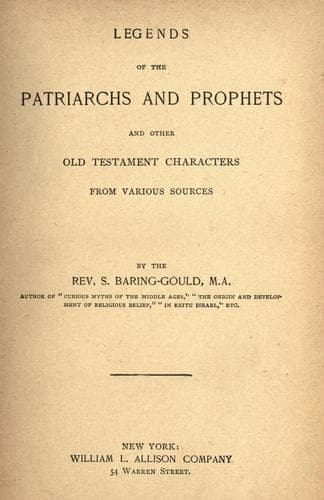
Legends of the Patriarchs and Prophets: And Other Old Testament Characters from Various SourcesBaring-Gould, S. (Sabine)
Religion
Legends of the Patriarchs and Prophets: And Other Old Testament Characters from Various Sources
Baring-Gould, S. (Sabine)
Bible. Old Testament -- Legends
We have also the same catastrophe somewhat differently related by
Ovid. The world he represents “as confederate in crime,” and doomed
therefore to just punishment. Jupiter sends down rain from heaven, and
rivers and seas gushing forth from their caves gather over the earth’s
surface, and sweep mankind away. Deucalion and his wife alone, borne in
a little skiff, are stranded on the top of Parnassus. By degrees, the
waters subside: the only surviving pair inquire of the gods how they
may again people the desert earth. They are ordered, with veiled heads,
to throw behind them the bones of their great mother. Half doubtful as
to the meaning of the oracle, they throw behind them stones, which are
immediately changed into men and women, and the earth spontaneously
produces the rest of the animal creation.[219]
Apollodorus relates the matter thus:--“When Zeus determined to destroy
the brazen race, Deucalion, by the advice of Prometheus, made a great
ark, λάρναξ, and put into it all necessary things, and entered it with
Pyrrha. Zeus then, pouring down heavy rains from heaven, overwhelmed
the greater part of Greece, so that all men perished except a few who
fled to the highest mountains. He floated nine days and nights in the
sea of waters, and at last stopped on Mount Parnassus. Then Zeus sent
Hermes to ask him what he wished, and he solicited that mankind might
be made again. Zeus bade him throw stones over his head, from which men
should come, and said that those cast by Pyrrha should be turned into
women.”
Stephanus of Byzantium says that the tradition was that after the
surface of the earth became dry, Zeus ordered Prometheus and Athene
to make images of clay in the form of men; and when they were dry, he
called the winds and made them breathe into each, and rendered them
vital: and thus the earth after the Flood was repeopled.[220] Diodorus
says, “In the Deluge, which happened in the time of Deucalion, almost
all flesh died.”[221]
The Chinese begin their dynasties with Jao, the last of the old race,
whose words are thus recorded in the Schu-Kiug:--“The mighty waters
of the flood spread themselves out, and overflowed, and drowned every
thing. The mountains disappeared in the deep, and the hills were buried
beneath them. The foaming billows seemed to threaten heaven. All people
were drowned.”[222] An ancient inscription, which the Chinese attribute
to Yu, the third patriarch after the Flood, and which at least dates
from before Christ, refers to this event:--“The illustrious Emperor
Jao said, sighing, ‘Companions and counsellors! The great and little
territories up to the mountain’s peak, the homes of birds, and wild
beasts, were overflowed far and wide. Long had I forgotten my home; now
I rest upon the mountain top of Jo-lu.... The trouble is over, and the
misfortune is at an end; the streams of the south flow, clothes and
food are before us. The world is at rest, and the flying rain cannot
again destroy us.’”[223]
Public-domain text, read in full here on John Shaqi.
Reviews
Reviews
No reviews yet
Be the first to share your thoughts on this work.
Elsewhere in the archive
Join the Discussion
Join the discussion
Sign in to leave a comment or review.
Sign InorCreate an account