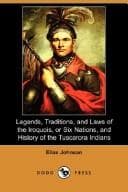
Legends, Traditions, and Laws of the Iroquois, or Six Nations, and History of the Tuscarora IndiansJohnson, Elias
History
Legends, Traditions, and Laws of the Iroquois, or Six Nations, and History of the Tuscarora Indians
Johnson, Elias
Iroquois Indians; Tuscarora Indians
Wilson Jacobs, 1st N. Y., Vet. Cav., Co. M.
Edward Spencer (Edward Anderson), Inv. sway. Co. A. 17th Corps.
Alvis D. Hewett, 151st N. Y. Vol's.
Thomas Cornelius, Co. K, 2d N. Y. Mounted Rifles.
Charles Green, 120th N. Y. Vol's, Co. K.
John Longboard, Samuel Mt. Pleasant.
During the war, Cornelius C. Cusick was promoted to First Lieutenant, and
at the close of the war he was promoted to Captain. He was some time
afterwards commissioned into the regular army of the United States as
First Lieutenant.
Antique Rock Citadel of Kienuka;
OR, GAU-STRAU-YEA.
There has been much said by different writers of aboriginal forts, and
fort builders of western New York, in availing themselves of steeps,
gulfs, defiles, and other marked localities, in establishing works for
security or defense. This trait is, however, in no case more strikingly
exemplified than in the curious antique work of Kienuka. The term
"Kienuka," means the stronghold or fort; but the original name of this
fort is Gau-strau-yea, which means bark laid down; this has a
metaphorical meaning, in the similitude of a freshly peeled slippery elm
bark, the size of the fort and laid at the bottom as a flooring, so that
if any person or persons go in they must be circumspect, and act
according to the laws of the fort, or else they will slip and fall down
to their own destruction.
The citadel of Kienuka is situated about four miles eastward of the inlet
of Niagara gorge at Lewiston, on a natural escarpment of the ridge on the
Tuscarora reservation, known at present by the name of the Old Saw Mill.
There is quite an interesting tradition connected with the antique fort
Gau-strau-yea. At the formation of the confederacy of the Iroquois, there
was a virgin selected from a nation which was called Squawkihaws (a
remote branch of the Seneca nation), and was ordained a Queen or
Peacemaker, who was stationed at this fort to execute her office of
peace, her official name was Ge-keah-saw-sa.
The fort was built by the Senecas aided by the Squawkihaws, on an
eminence on the north side of a steep of perpendicular rocks, which was
about eight or ten feet down; and on the east, south and west sides they
dug a trench four or five feet deep, and in this trench were placed
timbers which were put up perpendicularly and jointed as close as
possible, they projected above the ground ten or twelve feet, inclosing a
place of about twenty by fifty rods. The house for the Queen was in the
center of this inclosure or fort, and adjacent houses were built in two
rows, with a trail or path between them directing towards the Queen's
house; on each end and inside of the fort, which ran lengthwise east and
west, was an entrance corresponding with the trail prepared leading to
the house of the Queen.
Public-domain text, read in full here on John Shaqi.
Reviews
Reviews
No reviews yet
Be the first to share your thoughts on this work.
Elsewhere in the archive
Join the Discussion
Join the discussion
Sign in to leave a comment or review.
Sign InorCreate an account