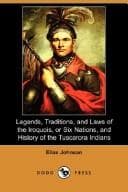
Legends, Traditions, and Laws of the Iroquois, or Six Nations, and History of the Tuscarora IndiansJohnson, Elias
History
Legends, Traditions, and Laws of the Iroquois, or Six Nations, and History of the Tuscarora Indians
Johnson, Elias
Iroquois Indians; Tuscarora Indians
It has always been a question in my mind who those white men were, to
give such rash advice. Were they Quakers? But what motive had they in
advising, from which so great a disaster was the result? Or, were they
men in disguise, from the county of Bath, in which the massacre was
committed, to make the Indians believe that they were Quakers, as the two
counties were in arms against each other at that time.
To coroborate the tradition above, I would call your attention to part of
a letter from President Pollock to Lord Craven, in the year 1712, who
attributes the calamity thus:
"Our divisions," says he, "chiefly occasioned by the Quakers and some
other ill-disposed persons, have been the cause of all the troubles, for
the Indians were informed by some of the traders that the people who
lived here are only a few vagabonds, who had run away from other
governments and settled here of their own accord, without any authority,
so that if they were cut off, there would be none to revenge them. This
with their seeing our differences rise to such a heighth, that consisting
of two counties only, were in arms one against the other, encouraged them
to fall upon the county of Bath, expecting it would have no assistance
from this nor any other of the English plantations. This is the chief
cause that moved the Indians to rise against us, as far as I understand."
The Tuscaroras never had the inclination of cutting off the inhabitance
of the pale faces. Nevertheless, they did not always remain idle or
unconcerned spectators of the feuds and dissensions that so long
prevailed among the white people, toward the red men. The successive and
regular encroachments, on their hunting grounds and plantations, which
the increase of the European population occasioned, had not always been
submitted to without murmur.
Although they were pleased with the neighbors, from whom they had trade
for their furs, and could procure spirituous liquors and other articles,
which tended to the gratification of their real or imaginary wants. And
they were required to surrender larger and larger portions of their
domain, and at last, the removal of families from the neighborhood of
their long cherished memories of the graves of their ancestors, to the
more distant and less valuable tracts of land. Other causes of animosity
and ill-will were not wanting. Their hunters were shot down like so many
beasts, at the edge of the settlement, killed in their wigwams, their
young females' chastity violated, and many other things might be related,
which their tradition shows. But I have neither heart nor inclination to
bring to a resurrection the long gone-by memories of our forefathers. I
would that all were cast into oblivion, where might not be found neither
trace nor track; but rather that the chain of friendship which has
existed for more than a century between the Tuscaroras and the United
States Government may be made brighter and brighter as time rolls on.
Public-domain text, read in full here on John Shaqi.
Reviews
Reviews
No reviews yet
Be the first to share your thoughts on this work.
Join the Discussion
Join the discussion
Sign in to leave a comment or review.
Sign InorCreate an account