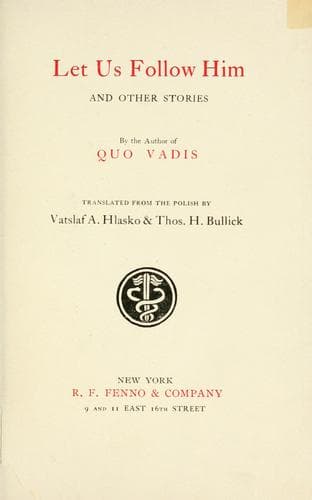
Jesus Christ -- Crucifixion -- Fiction; Palestine -- History -- To 70 A.D. -- Fiction; Polish fiction -- Translations into English
He knew how to talk of these trifles, as a specialist and connoisseur,
with toothless old men, who decked out their baldness in wreaths of
roses when going to a feast, and who after the feast chewed heliotrope
blossoms to make the breath of their lungs odoriferous. He felt also the
beauty of Cicero's periods, and of verses of Horace or Ovid.
Educated by an Athenian rhetor, he conversed in Greek fluently; he knew
whole pages of the "Iliad" by heart, and during a feast could sing odes
of Anacreon till he had grown hoarse or drunk. Through his master and
other rhetors he had rubbed against philosophy, and become sufficiently
acquainted with it to know the plans of various edifices of thought
reared in Hellas and the colonies; he understood too that all these
edifices were in ruins. He knew many Stoics personally; for these he
cherished dislike, since he looked on them rather as a political party,
and, besides, as hypochondriacs, hostile to joyous living. Sceptics had
a seat frequently at his table; and during intervals between courses
they overturned entire systems, and announced at their cups, filled
with wine, that pleasure was vanity, truth something unattainable, and
that the object of a sage could be only dead rest.
All this struck Cinna's ears without piercing to the depth. He
recognized no principle, and would have none. In Cato he saw the union
of great character and great folly. He looked on life as a sea, on which
winds blew whithersoever they listed; and wisdom in his eyes was the art
of setting sails in such fashion that they would urge one's boat
forward. He esteemed his own broad shoulders and sound stomach; he
esteemed his own beautiful Roman head, with his aquiline nose and
powerful jaws. He was certain that with these he could pass through life
somehow.
Though not belonging to the school of Sceptics, he was a practical
Sceptic and hence a lover of pleasure, though he knew that pleasure was
not happiness. The genuine teaching of Epicurus he did not know; hence
he considered himself an Epicurean. In general he looked on philosophy
as mental fencing, as useful as that which was taught by the
sword-master. When discourses on it wearied him, he went to the circus
to see blood.
He did not believe in the gods any more than in virtue, truth, and
happiness. He believed only in soothsaying, and had his own
superstitions; moreover, the mysterious beliefs of the Orient roused his
curiosity. To slaves he was a good master, unless when occasional tedium
brought him to cruelty. He thought life a great amphora, which was the
more valuable the better the wine contained in it; hence he tried to
fill his own with the best. He did not love any one, but he loved many
things, among others his own eagle-like face with splendid skull, and
his shapely patrician foot.
In the first years of his frolicking life he loved also to astound Rome,
and succeeded a number of times. Later he grew as indifferent to that as
to other things.
CHAPTER II.
Public-domain text, read in full here on John Shaqi.
Reviews
Reviews
No reviews yet
Be the first to share your thoughts on this work.
Join the Discussion
Join the discussion
Sign in to leave a comment or review.
Sign InorCreate an account