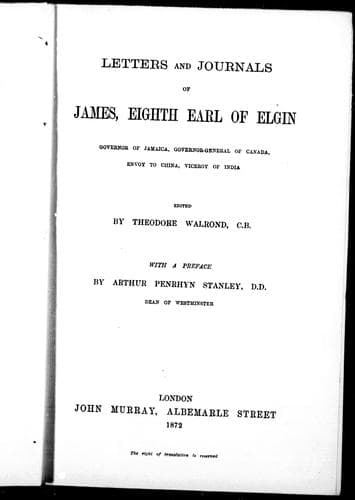
Letters and Journals of James, Eighth Earl of ElginElgin, James Bruce, Earl of
History
Letters and Journals of James, Eighth Earl of Elgin
Elgin, James Bruce, Earl of
Great Britain -- Colonies -- Administration -- History -- 19th century
appearance of a crowd of Arabs who poured out of a village to offer us
their aid in various ways. We had been told before we started, that a
party who had visited the Pyramids the night before had been a good
deal victimised by these Arabs, who, alas! in these degenerate days,
have no other mode of indulging their predatory propensities than by
exacting the greatest possible amount of 'backshish' from travellers
who visit the Pyramids. We pushed on over the heaps of sand and
_débris_, or probably covered-up tombs, which surround the base of the
Pyramids, when we suddenly came in face of the most remarkable object
on which my eye ever lighted. Somehow or other I had not thought of
the Sphinx till I saw her before me. There she was in all her imposing
magnitude, crouched on the margin of the Desert, looking over the
fertile valley of the Nile, and her gaze fixed on the East as if in
earnest expectation of the sun-rising. And such a gaze! The mystical
light and deep shadows cast by the moon, gave to it an intensity which
I cannot attempt to describe. To me it seemed a look, earnest,
searching, but unsatisfied. For a long time I remained transfixed,
endeavouring to read the meaning conveyed by this wonderful eye; but I
was struck after a while by what seemed a contradiction in the
expression of the eye and of the mouth. There was a singular
gentleness and hopefulness in the lines of the mouth, which appeared
to be in contrast with the anxious eye. Mr. Bowlby, who was a very
_sympathique_ inquirer into the significancy of this wonderful
monument, agreed with me in thinking that the upper part of the face
spoke of the intellect striving, and striving vainly, to solve the
mystery--(What mystery? the mystery, shall we say, of God's universe
or of man's destiny?)--while the lower indicated a moral conviction
that all must be well, and that this truth would in good time be made
manifest.
Public-domain text, read in full here on John Shaqi.
Reviews
Reviews
No reviews yet
Be the first to share your thoughts on this work.
Elsewhere in the archive
Join the Discussion
Join the discussion
Sign in to leave a comment or review.
Sign InorCreate an account