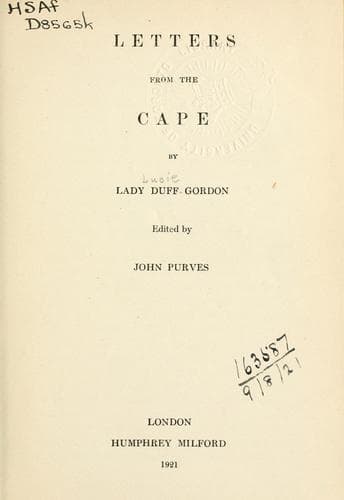
Cape of Good Hope (South Africa) -- Description and travel
A good breakfast,—and we paid ninepence for all.
This morning we started before eight, as it looked gloomy, and came
through a superb mountain defile, out on to a rich hillocky country,
covered with miles of corn, all being cut as far as the eye could reach,
and we passed several circular threshing-floors, where the horses tread
out the grain. Each had a few mud hovels near it, for the farmers and
men to live in during harvest. Altogether, I was most lucky, had two
beautiful days, and enjoyed the journey immensely. It was most
‘_abentheuerlich_’; the light two-wheeled cart, with four wild little
horses, and the marvellous brown driver, who seemed to be always going to
perdition, but made the horses do apparently impossible things with
absolute certainty; and the pretty tiny boy who came to help his uncle,
and was so clever, and so preternaturally quiet, and so very small: then
the road through the mountain passes, seven or eight feet wide, with a
precipice above and below, up which the little horses scrambled; while
big lizards, with green heads and chocolate bodies, looked pertly at us,
and a big bright amber-coloured cobra, as handsome as he is deadly,
wriggled across into a hole.
Nearly all the people in this village are Dutch. There is one Malay
tailor here, but he is obliged to be a Christian at Caledon, though
Choslullah told me with a grin, he was a very good Malay when he went to
Capetown. He did not seem much shocked at this double religion, staunch
Mussulman as he was himself. I suppose the blacks ‘up country’ are what
Dutch slavery made them—mere animals—cunning and sulky. The real
Hottentot is extinct, I believe, in the Colony; what one now sees are all
‘Bastaards’, the Dutch name for their own descendants by Hottentot women.
These mongrel Hottentots, who do all the work, are an affliction to
behold—debased and _shrivelled_ with drink, and drunk all day long;
sullen wretched creatures—so unlike the bright Malays and cheery pleasant
blacks and browns of Capetown, who never pass you without a kind word and
sunny smile or broad African grin, _selon_ their colour and shape of
face. I look back fondly to the gracious soft-looking Malagasse woman
who used to give me a chair under the big tree near Rathfelders, and a
cup of ‘bosjesthée’ (herb tea), and talk so prettily in her soft
voice;—it is such a contrast to these poor animals, who glower at one
quite unpleasantly. All the hovels I was in at Capetown were very fairly
clean, and I went into numbers. They almost all contained a handsome
bed, with, at least, eight pillows. If you only look at the door with a
friendly glance, you are implored to come in and sit down, and usually
offered a ‘coppj’ (cup) of herb tea, which they are quite grateful to one
for drinking. I never saw or heard a hint of ‘backsheesh’, nor did I
ever give it, on principle and I was always recognised and invited to
come again with the greatest eagerness. ‘An indulgence of talk’ from an
Public-domain text, read in full here on John Shaqi.
Reviews
Reviews
No reviews yet
Be the first to share your thoughts on this work.
Join the Discussion
Join the discussion
Sign in to leave a comment or review.
Sign InorCreate an account