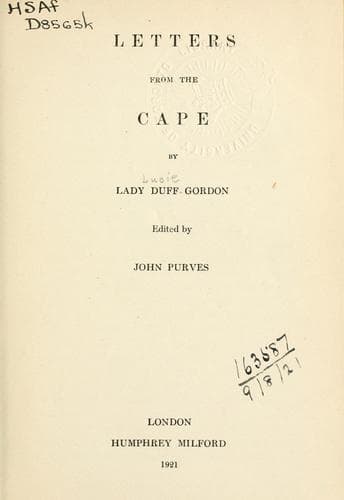
Cape of Good Hope (South Africa) -- Description and travel
This climate is evidently a styptic of great power, I shall write a few
lines to the _Lancet_ about Caledon and its hot baths—‘Bad Caledon’, as
the Germans at Houw Hoek call it. The baths do not concern me, as they
are chalybeate; but they seem very effectual in many cases. Yet English
people never come here; they stay at Capetown, which must be a furnace
now, or at Wynberg, which is damp and chill (comparatively); at most,
they get to Stellenbosch. I mean visitors, not settlers; _they_ are
everywhere. I look the colour of a Hottentot. Now I _must_ leave off.
Your most affectionate
L. D. G.
LETTER VII
GNADENTHAL
Caledon, Jan. 28th.
WELL, I have been to Gnadenthal, and seen the ‘blooming parish’, and a
lovely spot it is. A large village nestled in a deep valley, surrounded
by high mountains on three sides, and a lower range in front. We started
early on Saturday, and drove over a mighty queer road, and through a
river. Oh, ye gods! what a shaking and pounding! We were rattled up
like dice in a box. Nothing but a Cape cart, Cape horses, and a
Hottentot driver, above all, could have accomplished it. Captain D—
rode, and had the best of it. On the road we passed three or four farms,
at all which horses were _galloping out_ the grain, or men were winnowing
it by tossing it up with wooden shovels to let the wind blow away the
chaff. We did the twenty-four miles up and down the mountain roads in
two hours and a half, with our valiant little pair of horses; it is
incredible how they go. We stopped at a nice cottage on the hillside
belonging to a _ci-devant_ slave, one Christian Rietz, a _white_ man,
with brown woolly hair, sharp features, grey eyes, and _not_ woolly
moustaches. He said he was a ‘Scotch bastaard’, and ‘le bon sang
parlait—très-haut même’, for a more thriving, shrewd, sensible fellow I
never saw. His _father_ and master had had to let him go when all slaves
were emancipated, and he had come to Gnadenthal. He keeps a little inn
in the village, and a shop and a fine garden. The cottage we lodged in
was on the mountain side, and had been built for his son, who was dead;
and his adopted daughter, a pretty coloured girl, exactly like a southern
Frenchwoman, waited on us, assisted by about six or seven other women,
who came chiefly to stare. Vrouw Rietz was as black as a coal, but _so_
pretty!—a dear, soft, sleek, old lady, with beautiful eyes, and the kind
pleasant ways which belong to nice blacks; and, though old and fat, still
graceful and lovely in face, hands, and arms. The cottage was thus:—One
large hall; my bedroom on the right, S—’s on the left; the kitchen behind
me; Miss Rietz behind S—; mud floors daintily washed over with fresh
cow-dung; ceiling of big rafters, just as they had grown, on which rested
Public-domain text, read in full here on John Shaqi.
Reviews
Reviews
No reviews yet
Be the first to share your thoughts on this work.
Join the Discussion
Join the discussion
Sign in to leave a comment or review.
Sign InorCreate an account