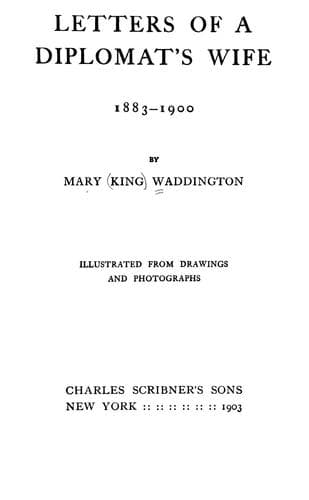
Letters of a Diplomat's Wife, 1883-1900Waddington, Mary King
History
Letters of a Diplomat's Wife, 1883-1900
Waddington, Mary King
Europe -- Social life and customs
I asked to have the maid at once--so Adelaide appeared with hot water
and a cup of tea, and I dressed as comfortably as if I was in my
dressing-room at the Rue Dumont d'Urville. As soon as I was ready I went
into the big carriage, which looked very nice and clean, had been swept
and dusted, window-panes washed (Adelaide saw the men doing it); a very
nice little breakfast tray was brought, tea, every variety of good
little rolls, and some fish. We contented ourselves with the rolls,
didn't experiment upon the fish. The table was close to the window--all
the gentlemen came up and talked to us, and as usual there were
quantities of people about.
We have passed through most desolate country, miles of plains, with
scarcely any traces of human habitation. The cottages are very few and
far between--generally a collection of little wood hovels, or "isbas,"
as they are called. We go long distances without seeing houses, fences,
gates, or even a road. At all the stations there are people--the big
ones crowded--and at the smaller ones, where we hardly stop, merely
slacken, peasants--and such objects, one can hardly tell the men from
the women; long, unkempt hair, all barefooted, and all wearing a sort of
fur garment with a hole in the middle to pass the head through, and
which falls low down to their knees.
We have just had tea at Smolensk, which is very Russian looking, with
gilded domes and pink and green painted roofs. The gentlemen are smoking
and walking up and down the platform, always exciting great attention.
There are two rather pretty girls, with fair hair and red blouses, who
are giggling and looking, and evidently wish to be remarked.
We have gone on again now and are settled for the evening. The carriage
looks so comfortable, curtains drawn, lamps lighted, flowers on the
tables, and quantities of books and maps. Sesmaisons and Corcelle have
just been in with their maps and Napoleon's Memoirs. It is most
interesting to follow it all. They read out bits here and there as we
passed through some well-known locality. At the Beresina, I think, where
the passage of the river was so awful--some of the men quite exhausted,
and yet not wanting to lie down on the snow, made themselves seats out
of the dead bodies of their comrades. What an awful retreat!
We have crossed the Beresina, where we saw a long procession of wood
rafts. They are of the most primitive description--long logs lashed
together, and in the middle a sort of cabin or hovel, where the women
and children live. They were floating slowly down with the tide as we
passed, and singing a sort of sad, monotonous chaunt, which sounded
weird and pathetic, but impressionnant. They say all the Russian
National songs have that undercurrent of sadness.
Public-domain text, read in full here on John Shaqi.
Reviews
Reviews
No reviews yet
Be the first to share your thoughts on this work.
Join the Discussion
Join the discussion
Sign in to leave a comment or review.
Sign InorCreate an account