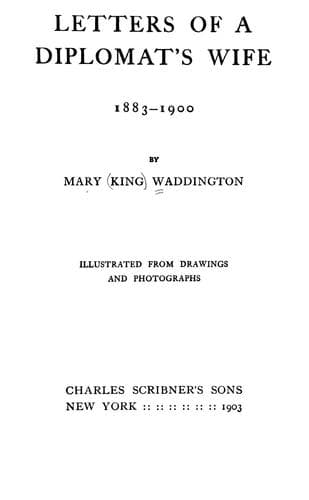
Letters of a Diplomat's Wife, 1883-1900Waddington, Mary King
History
Letters of a Diplomat's Wife, 1883-1900
Waddington, Mary King
Europe -- Social life and customs
This afternoon I have had my farewell audience from the Queen at
Buckingham Palace at 4 o'clock. I wore as usual the blue velvet, which
will walk about alone soon, as it has done all the ceremonies lately; my
pearls, and a creme velvet bonnet with light blue feathers. I went in
the ordinary open carriage (not gala). The gala carriage with the
powdered wigs, big footmen, canes, etc., went out yesterday for the last
time to the Drawing-room. I had some difficulty in getting into the
court-yard, which was filled with carriages, luggage-vans, soldiers,
etc., as the Queen was leaving this afternoon for Windsor. I was sent
from one entrance to another, in spite of the tricolour cockade, and
finally drew up at a side-door (where a shabby little victoria was
standing). A man in ordinary black livery appeared, and after a short
parley (in which I intervened myself, saying that I was the French
Ambassadress and had an audience with the Queen) he showed me into a
room on the ground floor. I waited about 15 minutes (it was 5 minutes to
4 when I arrived) and then Lady Southampton, Lady in Waiting, appeared,
with many apologies for being late--she didn't think I would come so
soon (and I was a little afraid of being late, they kept me so long in
the court-yard). We went upstairs to a small drawing-room looking out on
the court-yard, and in about 10 minutes the same servant in black
appeared, saying, "The Queen is ready to receive the French
Ambassadress." Lady Southampton said she couldn't come, as the Queen
wished to see me alone, so I followed the servant down a long
corridor--he stopped at a door, knocked, a voice said "come in," and I
found myself in the Royal presence. It was a small, ordinary room,
rather like a sort of waiting-room, no traces of habitation, nothing
pretty or interesting. The Queen was standing, very simply dressed in
black (her travelling dress she said, she was starting at once for
Windsor) before a writing-table which was in the middle of the room,
covered with books and papers. She was most kind, made me sit down on
the sofa next to her, and said she was afraid she had kept me waiting,
but that she had been kept by a visit from Mr. Gladstone--she then
paused a moment, so I made a perfectly banal remark, "what a wonderful
man, such an extraordinary intelligence," to which she replied, "He is
very deaf." She expressed great regret at our departure, and hoped we
were sorry to leave England and all our friends, but after all Paris was
not very far off, and she hoped she should see me again. She was sure M.
Waddington would find plenty to do when he got back--would he continue
his literary work? I said he would certainly have plenty to do, as he
was Senator and Membre de l'Institut, but that we should both miss the
Embassy life and the varied interests it brought. She repeated that she
hoped to see me again, so I asked if ever I came back to England might I
write to one of her ladies, and ask if I could be received. "Pray do,
Public-domain text, read in full here on John Shaqi.
Reviews
Reviews
No reviews yet
Be the first to share your thoughts on this work.
Elsewhere in the archive
Join the Discussion
Join the discussion
Sign in to leave a comment or review.
Sign InorCreate an account