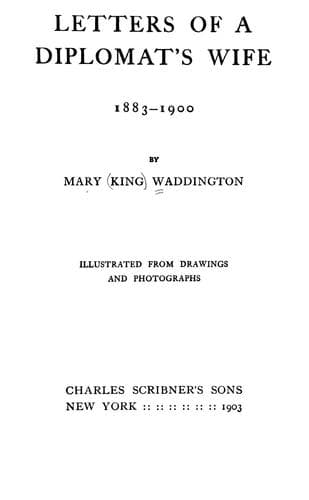
Letters of a Diplomat's Wife, 1883-1900Waddington, Mary King
History
Letters of a Diplomat's Wife, 1883-1900
Waddington, Mary King
Europe -- Social life and customs
and I shall not say good-bye, but au revoir." We talked about 15 minutes
about all sorts of things--some of our colleagues--our successor, etc.
She asked again who was coming to London, and said, "My last two
Ambassadors to France were ex-Viceroys." It seemed to me that she said
it on purpose, and that she wanted France to send one of her best men to
St. James's. I repeated the remark to my husband, and the chancellerie.
It is quite true. The present British Ambassador, Lord Dufferin, is
certainly the first diplomatist they have. He has had every
distinguished post England can offer--Ambassador to St. Petersburg and
Rome, Governor of Canada, and Viceroy of India, and has played a great
part. His predecessor, Lord Lytton, was also Viceroy of India, and very
distinguished, though in a different way from Lord Dufferin. I rather
fancy that Montebello would be an acceptable appointment. He knows
English well, has English relations, and I should think would like the
post, but I have really no idea. Some of the papers say that Ribot wants
the place, but I think he prefers home politics and would not care to
leave France; however, I could not tell the Queen anything definite. She
kissed me at parting, and gave me her photograph, signed, in a handsome
silver frame--then half turned her back, moving to a door on the other
side of the room, so that I could get out easily and not altogether a
reculons, which would have been awkward to open the door. I tucked my
parcel under my arm, opened the door myself (a thing I don't often do in
these days, except my bedroom door) and found myself again in the long
corridor. My audience was over, and I daresay I shall never see the
Queen again. She was unfailing to us both from the first moment, always
welcomed us with the same smile, was always inclined to talk about
anything and to understand and smooth over any little difficulty or
misunderstanding. I think she is a wonderful woman and a wonderful
Queen. In her long life she must have had many difficult questions and
responsibilities, and certainly England has not suffered under her rule.
I met Lady S. in the corridor, who came downstairs with me, and said she
was quite sure the Queen meant it when she said she would like to see me
again, that she _never_ said anything she didn't mean.
Public-domain text, read in full here on John Shaqi.
Reviews
Reviews
No reviews yet
Be the first to share your thoughts on this work.
Elsewhere in the archive
Join the Discussion
Join the discussion
Sign in to leave a comment or review.
Sign InorCreate an account