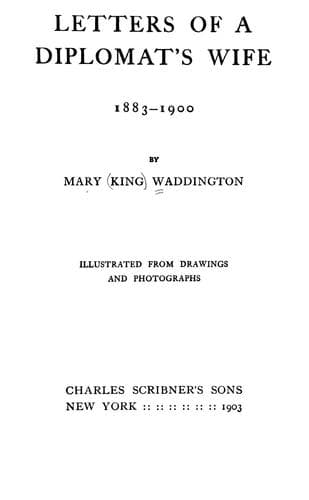
Letters of a Diplomat's Wife, 1883-1900 — John Shaqi
Letters of a Diplomat's Wife, 1883-1900Waddington, Mary King
History
Letters of a Diplomat's Wife, 1883-1900
Waddington, Mary King
Europe -- Social life and customs
Benckendorff stayed to breakfast, and we told him his place would be
always ready for him at breakfast and dinner. The hours of standing
apparently will be something awful. About 3.30 Mdme. Jaures came for
me, and we went to see Lady Thornton, who is Doyenne of the Corps
Diplomatique, but didn't find her. The Jaures have just arrived
themselves with all the Corps Diplomatique from Petersburg. They said
the starting from there was frightfully mismanaged, not nearly carriages
enough for the people and their luggage. The Ambassadors furious,
railway officials distracted, a second train had to be prepared which
made a long delay, and a general uproar. The only man who was quite
quiet and happy was Mr. Mackay (Silver King from California). He formed
part of the United States Mission, had his own private car attached to
the train, in which were Mrs. Mackay and Mr. and Mrs. Hunt (U. S.
Minister and his wife), and was absolutely independent.
After leaving our cards we drove through the Tverskaya, the main street.
There were quantities of people, and vehicles of every description, from
the Ambassadors' carriages (all with small, black Russian horses, a
Russian coachman in caftan and flat cap, and a gorgeous chasseur, all
gold braid, and hat with feathers, beside him), to the most ordinary
little drosky or fiacre. Nigra, the Italian Ambassador, passed us going
very quickly with the regular Russian attelage--3 horses, one scarcely
harnessed, galloping almost free on one side.
All the houses are dressed with red and gold draperies, and immense
tribunes put up all along the street, as the procession passes through
it from one end to the other when the Emperor makes his formal entrance
to-morrow. There are crowds of peasants and country people, all the men
in flannel shirts tucked into their trousers, and the women with a
handkerchief or little shawl over their heads. They don't look the least
gay, or excited, or enthusiastic; on the contrary, it is generally a sad
face, principally fair, and blue eyes. They stand, apparently a compact
mass, in the middle of the street, close up to the carriages, which can
scarcely get on--then comes a little detachment of Cossacks (most
curious looking, quite wild, on very small horses, and enormous long
lances), rides into the crowd and over them. They make no resistance,
don't say anything, and close up again, as soon as the carriage
passes--and so it goes on all day.
Public-domain text, read in full here on John Shaqi.
Reviews
Reviews
No reviews yet
Be the first to share your thoughts on this work.
Join the Discussion
Join the discussion
Sign in to leave a comment or review.
Sign InorCreate an account