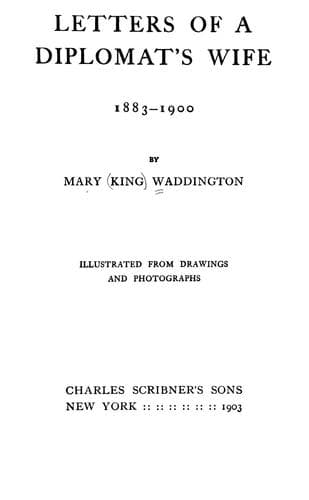
Letters of a Diplomat's Wife, 1883-1900Waddington, Mary King
History
Letters of a Diplomat's Wife, 1883-1900
Waddington, Mary King
Europe -- Social life and customs
extremely well--of course I couldn't tell if her sight was gone, as she
knew I was coming and I sat close to her. Her eyes were blue and clear,
and her memory and conversation quite the same. She thanked me for my
letter; said the Duke of Edinburgh's death was a great blow to her. It
was so sudden, she had not thought him ill. She had lost three children
all very dear to her, and it was hard at her age to see her children go
before her. She spoke at once (so moderately) of the caricatures and
various little incidents that had occurred in France. I said I was very
glad to have an opportunity of telling her that everybody in France
(except for a few hot-headed radicals and anti-English) was most
indignant at such gratuitous insults not only to the Queen but to a
woman. She said she quite understood that--that wherever she had been in
France everybody had done what they could to make her stay happy and
comfortable; that she never could forget it, and hoped the French nation
felt that--also that she would never dream of holding the country
responsible for the radical press, but "my children and my people feel
it very deeply." We talked about the King of Italy's murder (she was
much pleased with the expression in one of the Italian papers "e morto
in piedi") and she expressed great sympathy for Queen Margherita--"She
is fond of Italy and is always thinking and planning what she can do for
the people." We also talked about the Shah and the attentat in Paris. I
said that left me rather indifferent, but she answered instantly, "You
are quite wrong--it is the principle, not the person, that is attacked
in those cases." I then remarked that it was a great pity, I thought,
that one of those gentlemen (anarchists, not sovereigns) shouldn't be
lynched; that I believed the one thing they were afraid of was the
justice of the people. She said, "That is not a very Christian
sentiment"; but I think she didn't altogether disagree with me. She
asked me about Francis--was he working for diplomacy; and then, I don't
know exactly how, we began talking about mixed marriages. She said she
didn't think religion ought to be an invincible obstacle. I said I
thought with her, but that French Protestants were very strict. I told
her it had been said that my husband, who was certainly a very
large-minded man in most things, was really narrow about Catholics. She
said, with such a charming smile, "Oh, I can't think M. Waddington was
ever narrow about anything, I always thought him one of the most
large-minded, just men I ever knew." I must say I was pleased, and W.
always felt that for some reason or another he was sympathetic to her.
We talked a little about the Empress Frederick; she said the last news
was better, but she evidently didn't want to pursue the subject. We
talked on some little time, and when she finally dismissed me, she said,
"I hope you will come back to England, and whenever you do I shall be
Public-domain text, read in full here on John Shaqi.
Reviews
Reviews
No reviews yet
Be the first to share your thoughts on this work.
Elsewhere in the archive
Join the Discussion
Join the discussion
Sign in to leave a comment or review.
Sign InorCreate an account