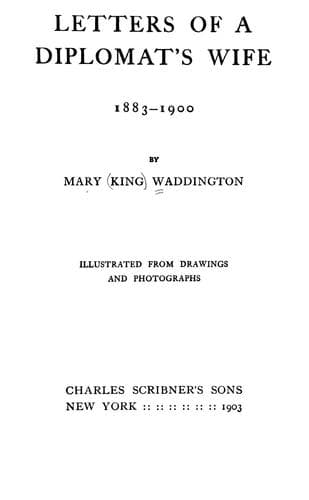
Letters of a Diplomat's Wife, 1883-1900Waddington, Mary King
History
Letters of a Diplomat's Wife, 1883-1900
Waddington, Mary King
Europe -- Social life and customs
very glad to see you." She shook hands--I backed myself to the door,
opened it, and there found the Highland servant, who took me back to the
drawing-room where the Duchess of Roxburghe was waiting. She suggested
that we should go for a turn in the garden, and when she went to get her
hat I looked about the room, which is quite plainly furnished--a grand
piano, comfortable furniture, not pretty, and no particular style.
We walked about the gardens a little, which are pretty, such quantities
of flowers, and had tea under the trees. Two of the ladies came
out--Mrs. Grant and Miss Harbord. They were very anxious to know if I
found the Queen changed after seven years, but I really can't say I did.
My impression is that they find her older. They say she felt the Duke of
Edinburgh's death very much, and that she is very worried about the
Empress Frederick, though she doesn't talk much about her. It was lovely
sitting under the trees, so cool and quiet after the noise and glare of
Cowes. All the people bowed as we drove home through Cowes. I think they
took Joseph in his black livery for one of the Queen's servants.
I must tell you that Joseph and Elise are also moving in high society.
Joseph came with a most smiling face to me Saturday night to say that
one of his friends was chef on the Empress's yacht (the Thistle) and had
invited them to breakfast on Sunday on the yacht. I said they could go,
and when Bessie and I were going to church we saw them start--he in the
regulation Cowes blue serge costume (_not_ the short, very short, Eton
jacket which is the dress attire of the Club men) and yellow shoes, and
she in my old purple foulard, with a very nice little toque. A very
smart little boat was waiting for them.
Now, my Dear, I must stop, as I am exhausted, and a perfect Mrs.
Jellyby, papers flying all over the place, as I am writing at the open
window, and ink all over me, fingers, hair, etc. I can't say, as Madame
de Sevigne did, "ma plume vole," for mine stops and scratches, and makes
holes in the paper, and does everything it can to make my writing
difficult. I wonder why I hate it so--I do--as soon as I sit down to my
writing-table I want to go out or play on the piano, or even crochet
little petticoats--anything rather than write. I suppose I shall never
see the Queen again--at her age it isn't very likely, especially if I
wait another seven years without coming over. I am glad she received me,
it was a great pleasure.
_Note._
#Paris, 29, Rue Auguste Vacquerie#,
Dimanche, 29 Decembre, 1901.
Of course I never saw the Queen again. She began to fail that same
autumn (1900) after her return home from Balmoral, and died at Osborne
the 22d of January, 1901--a beautiful death, painless, sleeping away and
all her children and grandchildren with her. It isn't only the Queen who
has disappeared--it is the century. England will enter on a new
phase--but it must be different from the chapter that has just closed.
INDEX
Public-domain text, read in full here on John Shaqi.
Reviews
Reviews
No reviews yet
Be the first to share your thoughts on this work.
Elsewhere in the archive
Join the Discussion
Join the discussion
Sign in to leave a comment or review.
Sign InorCreate an account