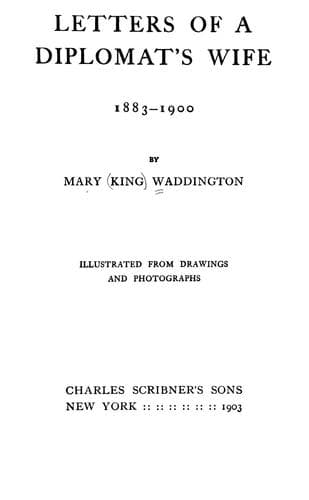
Letters of a Diplomat's Wife, 1883-1900Waddington, Mary King
History
Letters of a Diplomat's Wife, 1883-1900
Waddington, Mary King
Europe -- Social life and customs
The most interesting thing to me was the deputations from all the
provinces of this vast Empire--Kirghis, Moguls, Tartars, Kalmucks, etc.
There was a magnificent chief from the Caucase, all in white, with
jewelled sword and high cap (even from where we were, so high above the
crowd, we saw the flash of the diamonds); the Khan of Khiva, and the
Emir of Bokhara, both with high fur caps, also with jewels on cap and
belt. A young fellow, cousin I think of Prince Dolgourouky, came and
stood near me, and told me as well as he could who the most important
people were. Bells going all the time (and the Moscow bells have a deep,
beautiful sound), music, the steady tramp of soldiers, and the curious,
dull noise of a great crowd of people.
Then a break in the troops, and a long procession of gala court
carriages passed, with six horses and six runners, a man to each horse,
with all the grands-maitres and high officials of the Court, each man
covered with gold lace and embroidery, and holding his staff of office,
white with a jewel at the top. After that more troops, the Emperor's
body-guard, and then the Emperor himself. He was in full uniform, riding
quite alone in front on his little white horse which he had ridden in
the Turkish campaign. He looked quite composed and smiling, not a trace
of nervousness (perhaps a little pale), returned all the salutations
most graciously, and looked up, bowed and smiled to our balcony. A
little distance behind him rode his two sons, and close up to him on
the left rode the Duke of Edinburgh in red; any bomb thrown at the
Emperor must have killed the English Prince.
Then followed a long suite of Princes--some of their uniforms, Austrian,
Greek, and Montenegrian standing out well. From that moment there was
almost silence on the balcony; as the Emperor disappeared again all
crossed themselves, and everyone waited for the welcome sound from the
Kremlin.
After a long interval, always troops passing, came the Empress. She was
with her daughter, the little Grand Duchess Xenia, both in Russian
dress. The carriage was shut, a coupe, but half glass, so we saw them
perfectly, and the high head-dress (Kakoshnik) and white veil, spangled
with silver was very becoming. The carriage was very handsome, all gold
and paintings; six white horses led, and running footmen. The Empress
and her daughter were seated side by side, and on a curious sort of
_outside_ seat, on one side of the coupe, was a page, dressed in red and
yellow, a sort of cloth of gold, with high feathers in his cap. The
Empress looked grave and very pale, but she smiled and bowed all the
time. It must have been an awful day for her, for she was so far behind
the Emperor, and such masses of troops in between, that he might have
been assassinated easily, she knowing nothing of it.
Public-domain text, read in full here on John Shaqi.
Reviews
Reviews
No reviews yet
Be the first to share your thoughts on this work.
Join the Discussion
Join the discussion
Sign in to leave a comment or review.
Sign InorCreate an account