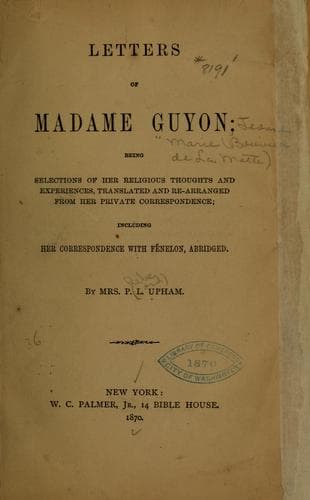
Letters of Madam GuyonGuyon, Jeanne Marie Bouvier de la Motte
Religion
Letters of Madam Guyon
Guyon, Jeanne Marie Bouvier de la Motte
Guyon, Jeanne Marie Bouvier de La Motte, 1648-1717
The discovery of your weakness and emptiness, is an evidence of God's
love; and while it is ground for humiliation, it is also of
thanksgiving. When it pleases God to fill this void with his grace, it
is cause of thankfulness; but if we realized at all times this
fullness, we should be in danger of appropriating the grace of God to
ourselves. Thus, our times of desolation are necessary, and we should
accept them joyfully, as a portion of the bread our father gives us.
Yours in tender sympathy.
SELF-ABANDONMENT.
The death of self is not accomplished at once. It is for some time a
living death. Its opposite, spiritual life, is represented by
Ezekiel's vision of the dry bones. First, the bones were rejoined;
afterwards covered with sinews; then the flesh appeared; and finally,
the spirit of the Lord animated them. When the soul begins to incline
towards God, it finds many obstructions; but in proportion as we yield
to the will of God, these obstructions are removed. The following
simile will help to illustrate my idea. The rivers empty themselves
into the sea; before they lose themselves there. Wave by wave
following its course, seems to urge onward the river, to lose itself in
the sea. God imparts to the soul some waves of pure love, to urge on
the soul to himself; but as the river does not lose itself in the sea,
until its own waters are exhausted, so the soul reaches God, and loses
itself in God, only when the means of supply from self are at an end.
As the waves, which are precipitated into the sea, roll many times
before they are lost in the sea, so the soul undergoes many changes,
before it is received into God.
The results of self-crucifixion are happy, because God then becomes all
to the soul. We lose self, and substitute God in its place. We take
away the finite, and receive the Infinite. This is blessed.
NO DEPENDENCE ON INSTRUMENTS.
Public-domain text, read in full here on John Shaqi.
Reviews
Reviews
No reviews yet
Be the first to share your thoughts on this work.
Join the Discussion
Join the discussion
Sign in to leave a comment or review.
Sign InorCreate an account