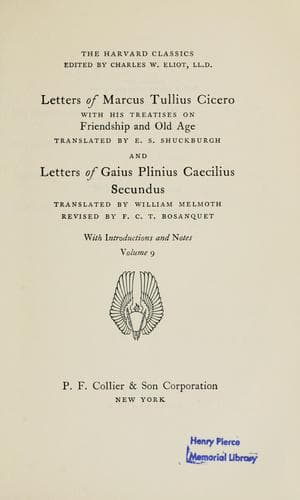
Letters of Marcus Tullius CiceroCicero, Marcus Tullius
History
Letters of Marcus Tullius Cicero
Cicero, Marcus Tullius
Authors, Latin -- Correspondence; Cicero, Marcus Tullius -- Correspondence; Statesmen -- Rome -- Correspondence
Many sides of Cicero's life other than the political are reflected in
the letters. From them we can gather a picture of how an ambitious
Roman gentleman of some inherited wealth took to the legal
profession as the regular means of becoming a public figure; of
how his fortune might be increased by fees, by legacies from
friends, clients, and even complete strangers who thus sought to
confer distinction on themselves; of how the governor of o
province could become rich in. a year; of how the sons of Roman
men of wealth gave trouble to their tutors, were sent to Athens, as
to a university in our day, and found an allowance of over $4,000 a
year insufficient for their extravagances. Again, we see the greatest
orator of Rome divorce his wife after thirty years, apparently
because she had been indiscreet or unscrupulous in money matters,
and marry at the age of sixty-three his own ward, a young girl
whose fortune he admitted was the main attraction. The coldness
of temper suggested by these transactions is contradicted in turn by
Cicero's romantic affection for his daughter Tullia, whom he is
never tired of praising for her cleverness and charm, and whose
death almost broke his heart.
Most of Cicero's letters were written in ink on paper or parchment
with a reed pen; a few on tablets of wood or ivory covered with
wax, the marks being cut with a stylus. The earlier letters he wrote
with his own hand, the later were, except in rare cases, dictated to
a secretary. There was, of course, no postal service, so the epistles
were carried by private messengers or by the couriers who were
constantly traveling between the provincial officials and the
capital.
Apart from the letters to Atticus, the collection, arrangement, and
publication of Cicero's correspondence seems to have been due to
Tiro, the learned freedman who served him as secretary, and to
whom some of the letters are addressed. Titus Pormponius Atticus,
who edited the large collection of the letters written to himself,
was a cultivated Roman who lived more than twenty years in
Athens for purposes of study. His zeal for cultivation was
combined with the successful pursuit of wealth; and though Cicero
relied on him for aid and advice in public as well as private
matters, their friendship did not prevent Atticus from being on
good terms with men of the opposite party.
Generous, amiable, and cultured, Atticus was not remarkable for
the intensity of his devotion either to principles or persons. "That
he was the lifelong friend of Cicero," says Professor Tyrrell, "is the
best title which Atticus has to remembrance. As a man he was
kindly, careful, and shrewd, but nothing more: there was never
anything grand or noble in his character. He was the quintessence
of prudent mediocrity."
Public-domain text, read in full here on John Shaqi.
Reviews
Reviews
No reviews yet
Be the first to share your thoughts on this work.
Join the Discussion
Join the discussion
Sign in to leave a comment or review.
Sign InorCreate an account