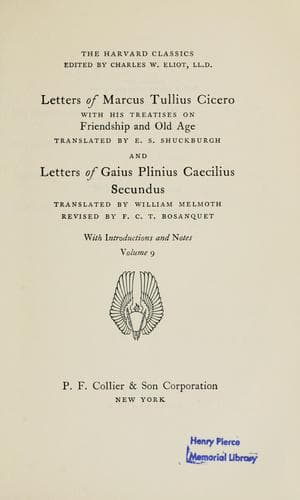
Letters of Marcus Tullius CiceroCicero, Marcus Tullius
History
Letters of Marcus Tullius Cicero
Cicero, Marcus Tullius
Authors, Latin -- Correspondence; Cicero, Marcus Tullius -- Correspondence; Statesmen -- Rome -- Correspondence
YOU have Messalla with you. What letter, therefore, can I write
with such minute care as to enable me to explain to you what is
being done and what is occurring in public affairs, more
thoroughly than he will describe them to you, who has at once the
most intimate knowledge of everything, and the talent for
unfolding and conveying it to you in the best possible manner? For
beware of thinking, Brutus--for though it is unnecessary for me to
write to you what you know already, yet I cannot pass over in
silence such eminence in every kind of greatness--beware of
thinking, I say, that he has any parallel in honesty and firmness,
care and zeal for the Republic. So much so that in him
eloquence--in which he is extraordinarily eminent--scarcely seems
to offer any opportunity for praise. Yet in this accomplishment
itself his wisdom is made more evident; with such excellent
judgment and with so much acuteness has he practised himself in
the most genuine style of rhetoric. Such also is his industry, and so
great the amount of midnight labour that he bestows on this study,
that the chief thanks would not seem to be due to natural genius,
great as it is in his case. But my affection carries me away: for it is
not the purpose of this letter to praise Mesalla, especially to
Brutus, to whom his excellence is not less known than it is to me,
and these particular accomplishments of his which I am praising
even better. Grieved as I was to let him go from my side, my one
consolation was that in going to you who are to me a second self,
he was performing a duty and following the path of the truest
glory. But enough of this. I now come, after a long interval of time,
to a certain letter of yours, in which, while paying me many
compliments, you find one fault with me--that I was excessive and,
as it were, extravagant in proposing votes of honour. That is your
criticism: another's, perhaps, might be that I was too stern in
inflicting punishment and exacting penalties, unless by chance you
blame me for both. If that is so, I desire that my principle in both
these things should be very clearly known to you. And I do not rely
solely on the dictum of Solon, who was at once the wisest of the
Seven and the only lawgiver among them. He said that a state was
kept together by two things--reward and punishment. Of course
there is a certain moderation to be observed in both, as in
everything else, and what we may call a golden mean in both these
things. But I have no intention to dilate on such an important
subject in this place.
Public-domain text, read in full here on John Shaqi.
Reviews
Reviews
No reviews yet
Be the first to share your thoughts on this work.
Elsewhere in the archive
Join the Discussion
Join the discussion
Sign in to leave a comment or review.
Sign InorCreate an account