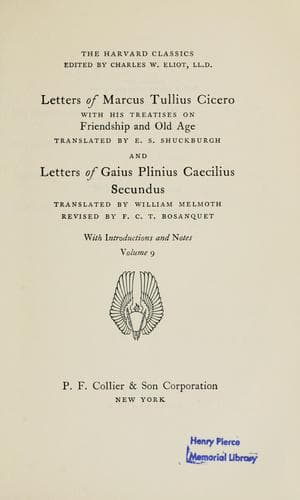
Letters of Marcus Tullius CiceroCicero, Marcus Tullius
History
Letters of Marcus Tullius Cicero
Cicero, Marcus Tullius
Authors, Latin -- Correspondence; Cicero, Marcus Tullius -- Correspondence; Statesmen -- Rome -- Correspondence
But what has been my aim during this war in the motions I have
made in the senate I think it will not be out of place to explain.
After the death of Caesar and your ever memorable Ides of March,
Brutus, you have not forgotten what I said had been omitted by you
and your colleagues, and what a heavy cloud I declared to be
hanging over the Republic. A great pest had been removed by your
means, a great blot on the Roman people wiped out, immense
glory in truth acquired by yourselves: but an engine for exercising
kingly power had been put into the hands of Lepidus and Antony,
of whom the former was the more fickle of the two, the latter the
more corrupt, but both of whom dreaded peace and were enemies
to quiet. Against these men, inflamed with the ambition of
revolutionizing the state, we had no protecting force to oppose. For
the fact of the matter was this: the state had become roused as one
man to maintain its liberty; I at the time was even excessively
warlike; you, perhaps with more wisdom, quitted the city which
you had liberated, and when Italy offered you her services declined
them. Accordingly, when I saw the city in the possession of
parricides, and that neither you nor Cassius could remain in it with
safety, and that it was held down by Antony's armed guards, I
thought that I too ought to leave it: for a city held down by traitors,
with all opportunity of giving aid cut off, was a shocking
spectacle. But the same spirit as always had animated me, staunch
to the love of country, did not admit the thought of a departure
from its dangers. Accordingly, in the very midst of my voyage to
Achaia, when in the period of the Etesian gales a south wind--as
though remonstrating against my design--had brought me back to
Italy, I saw you at Velia and was much distressed: for you were on
the point of leaving the country, Brutus--leaving it, I say, for our
friends the Stoics deny that wise men ever "flee." As soon as I
reached Rome I at once threw myself in opposition to Antony's
treason and insane policy: and having roused his wrath against me,
I began entering upon a policy truly Brutus-like--for this is the
distinctive mark of your family--that of freeing my country. The
rest of the story is too long to tell, and must be passed over by me,
for it is about myself. I will only say this much: that this young
Caesar, thanks to whom we still exist, if we would confess the
truth, was a stream from the fountain-head of my policy. To him I
voted honours, none indeed, Brutus, that were not his due. none
that were not inevitable. For directly we began the recovery of
liberty, when the divine excellence of even Decimus Brutus had
not yet bestirred itself sufficiently to give us an indication of the
truth, and when our sole protection depended on the boy who had
shaken Antony from our shoulders, what honour was there that he
did not deserve to have decreed to him? However, all I then
proposed for him was a complimentary vote of thanks, and that too
Public-domain text, read in full here on John Shaqi.
Reviews
Reviews
No reviews yet
Be the first to share your thoughts on this work.
Elsewhere in the archive
Join the Discussion
Join the discussion
Sign in to leave a comment or review.
Sign InorCreate an account