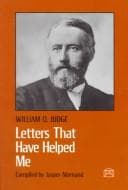
Judge, William Quan, 1851-1896; Theosophists -- United States -- Correspondence; Theosophy
I am not separate from anything. "I am that which is." That is, I am
Brahma, and Brahma is everything. But being in an illusionary world,
I am surrounded by certain appearances that seem to make me separate.
So I will proceed to mentally state and accept that I am all these
illusions. I am my friends,--and then I went to them in general and in
particular. I am my enemies; then I felt them all. I am the poor and
the wicked; I am the ignorant. Those moments of intellectual gloom are
the moments when I am influenced by those ignorant ones who are myself.
All this in my nation. But there are many nations, and to those I go in
mind; I feel and I am them all, with what they hold of superstition or
of wisdom or evil. All, all is myself. Unwisely, I was then about to
stop, but the whole is Brahma, so I went to the Devas and Asuras;[B]
the elemental world, that too is myself. After pursuing this course
awhile I found it easier to return to a contemplation of all men as
myself. It is a good method and ought to be pursued, for it is a step
toward getting into contemplation of the All. I tried last night to
reach up to Brahma, but darkness is about his pavilion.
Now what does all this insanity sound like? I'll tell you what: if it
were not for this insanity I would go insane. But shall I not take
heart, even when a dear friend deserts me and stabs me deep, when I
know that he is myself?
NAMASTAE!
Z.
* * * * *
I found the above letter still more valuable when I remembered that
Brahma is "the universal expansive force of Nature"--from _Brih_, to
expand; and so stated in an article by H. P. Blavatsky in _Five Years
of Theosophy_. In the _Dhammapada_ we are told to think ourselves to be
the sun and stars, the wet and dry, heat and cold; in short, to feel
all experience, for we can live all out in the mind.
J. N.
[Footnote B: Gods and demons.--J. N.]
V.
DEAR JASPER:
I wish I could answer your letter as you ought to have it done. But I
feel my inability. However, our duty is to never consider our ability,
but to do what comes to be done in whatever way we can, no matter how
inadequate the work appears to others. When we stop to consider our
weakness, we think, by comparison, of how another would do it. Our
_only right is in the act itself_. The consequences are in the great
Brahm. So I will just say what comes.
Public-domain text, read in full here on John Shaqi.
Reviews
Reviews
No reviews yet
Be the first to share your thoughts on this work.
Join the Discussion
Join the discussion
Sign in to leave a comment or review.
Sign InorCreate an account