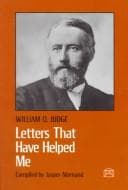
Judge, William Quan, 1851-1896; Theosophists -- United States -- Correspondence; Theosophy
Then he must place all his actions on devotion. That is, sacrifice all
his actions to the Supreme and not to himself. He must either (leaving
out indifference) set himself up as the God to whom he sacrifices, or
the other real God--Krishna, and all his acts and aspirations are done
either for himself or for the All. Here comes in the importance of
motive. For if he performs great deeds of valor, or of benefit to man,
or acquires knowledge so as to assist man, and is moved to that merely
because he thinks _he_ will attain salvation, he is only acting for his
own benefit and is therefore sacrificing to himself. Therefore he must
be devoted inwardly to the All; that is, he places all his actions on
the Supreme, knowing that he is not the doer of the actions, but is the
mere witness of them.
As he is in a mortal body, he is affected by doubts which will spring
up. When they do arise, it is because he is ignorant about something.
He should therefore be able to disperse doubt "by the sword of
knowledge." For if he has a ready answer to some doubt, he disperses
that much. All doubts come from the lower nature, and _never_ in any
case from higher nature. Therefore as he becomes more and more devoted
he is able to know more and more clearly the knowledge residing in his
Satwa part. For it says:
"A man who, perfected in devotion (or who persists in its cultivation)
finds spiritual knowledge spontaneously in himself in progress of
time." Also: "The man of doubtful mind enjoys neither this world nor
the other (the Deva world), nor final beatitude."
The last sentence is to destroy the idea that if there is in us this
higher self it will, even if we are indolent and doubtful, triumph over
the necessity for knowledge, and lead us to final beatitude in common
with the whole stream of man.
The three qualities are lower than a state called Turya, which is a
high state capable of being enjoyed even while in this body. Therefore
in that state, there exists none of the three qualities, but there the
soul sees the three qualities moving in the ocean of Being beneath.
This experience is not only met with after death, but, as I said, it
may be enjoyed in the present life, though of course consciously very
seldom. But even consciously there are those high Yogees who can and
do rise up to Nirvana, or Spirit, while on the earth. This state is
the fourth state, called Turya. There is no word in English which will
express it. In that state the body is alive though in deep catalepsy.
[Self-induced by the Adept.--J. N.] When the Adept returns from it
he brings back _whatever he can_ of the vast experiences of that
Turya state. Of course they are far beyond any expression, and their
possibilities can be only dimly perceived by us. I cannot give any
description thereof because I have not known it, but I perceive the
possibilities, and you probably can do the same.
Public-domain text, read in full here on John Shaqi.
Reviews
Reviews
No reviews yet
Be the first to share your thoughts on this work.
Join the Discussion
Join the discussion
Sign in to leave a comment or review.
Sign InorCreate an account