For many weeks this most infamous campaign was kept up in the columns of
_L’Echo de Paris_, _Le Petit Journal_, _Le Gaulois_, _La Libre Parole_,
and _L’Intransigeant_. So varied in character and so ingenious in
conception were these libellous tales, that it became impossible for the
friends of the condemned man to make an adequate defense. Dreyfus’s
counsel, Maître Demange, heard the stories, and could do nothing. The
verdict of the court-martial closed the door to legal redress. The
devoted wife of Dreyfus at first attempted to reply to them in _Le
Figaro_. Parisians laughed at her _naïveté_. She was not the only
deceived wife in the world, they said. At length, wearied of the unequal
combat--one woman against a horde of anti-Semitic vilifiers--she gave to
the world a volume of letters written by her husband to herself. It was
her desire simply to show him as he was, to rehabilitate the prisoner as
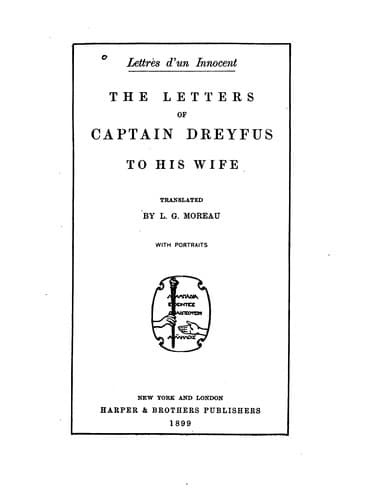
a husband and a father in the eyes of Frenchmen. But “Les Lettres d’un
Innocent” have done more than this. To the women of France, at least,
they have established the innocence of the man. No one can read these
letters without being struck by the absolute sincerity of the writer; by
his love for his wife and his family, and for his country; by his
devotion to duty and to the traditions of the army whose heads had so
remorselessly sacrificed him; by the utter hopelessness of his position.
When, in the papers of January 6, 1895, the story of his dramatic
degradation was published to the world, the French people pretended to
see in his proud, fearless demeanor, as his uniform was stripped of
insignia and his sword broken before him, a criminal stoicism that would
have been impossible in an innocent man. Many English and American
readers recognized simply the final desperate appeal of an entirely
innocent man. The sentiment that was then aroused outside of France will
be emphasized by “Les Lettres d’un Innocent.” Although not destined to
have the judicial and logical weight of the testimony before the Cour de
Cassation, they have a sympathetic and persuasive significance that is
eminently human. The evidence before the Court proves that Dreyfus did
not write the _bordereau_. The letters convince one that he was
incapable of treason.
The reader who expects to find in the epistles before us arguments
tending to prove the innocence of the writer will be disappointed. Even
if the prisoner actually attempted defense it was not allowed to pass
the censor. Only a persistent declaration of innocence will be found
here--a declaration that is repeated with awful and tragic monotony
until it smites the ear like the wail of an innocent soul in Dante’s
“Inferno.”
Public-domain text, read in full here on John Shaqi.
Reviews
Reviews
No reviews yet
Be the first to share your thoughts on this work.
Join the Discussion
Join the discussion
Sign in to leave a comment or review.
Sign InorCreate an account